Licence: Public Domain Mark
Credit: A system of dental surgery / by Sir John Tomes. Source: Wellcome Collection.
126/808 page 110
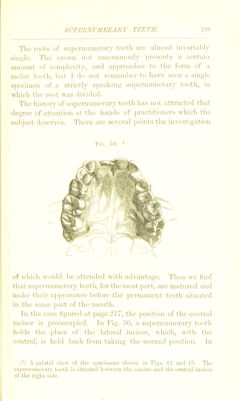
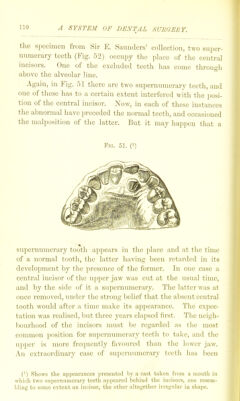
![the specimen from Sir E. Saunders' collection, two super- niimerary teeth (Fig. 52) occupy the place of the central incisors. One of the excluded teeth has come through above the alveolar line. Again, in Fig. 51 there are two supernumerarj^ teeth, and one of these has to a certain extent interfered with the posi- tion of the central incisor. Now, in each of these instances the abnormal have preceded the normal teetli, and occasioned the malposition of the latter. But it may happen that a Fio. 51. (') supernumerary tooth appears in the place and at tlie time of a normal tooth, the latter having been retarded in its development by the presence of the former. In one case a central incisor of the upper jaw was cut at the usual time, and by the side of it a supcrmimerary. The latter was at once removed, under the strong belief tliat the absent central tooth would after a time make its appearance. The expec- tation was realised, but three j'cars elapsed first. Tlie neigh- bourhood of tlie incisors must be regarded as the most common position for supcrmimerarv teeth to take, and tlio u]ipcr is more frequently favoured than tlie lower jaw. An extraordinary' case of supernumerary teetli lias been (') Shows tlic appearances ))reseuteil by a cast taken from a mouth in wliich two supernanicrary tcetli appeared liehind the incisors, one resem- bling to some e.xteut au incisor, the other alto^'etlier irregular in sliape.](https://iiif.wellcomecollection.org/image/b21499081_0126.jp2/full/800%2C/0/default.jpg)
 No text description is available for this image
 No text description is available for this image
 No text description is available for this image