[Report 1950] / Medical Officer of Health, Newport (Gwent) Port Health Authority.
- Newport (Wales). Port Health Authority.
- Date:
- 1950
Licence: Attribution 4.0 International (CC BY 4.0)
Credit: [Report 1950] / Medical Officer of Health, Newport (Gwent) Port Health Authority. Source: Wellcome Collection.
16/22 page 14
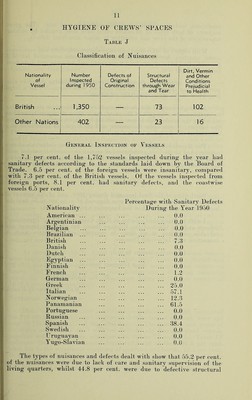
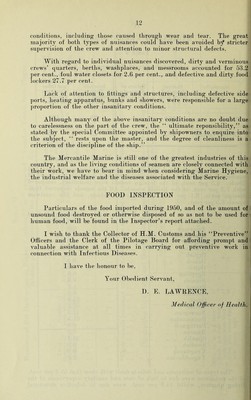
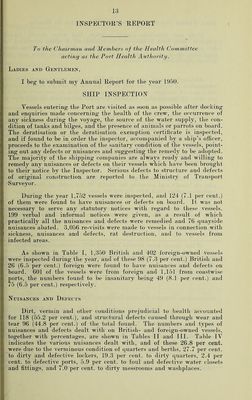
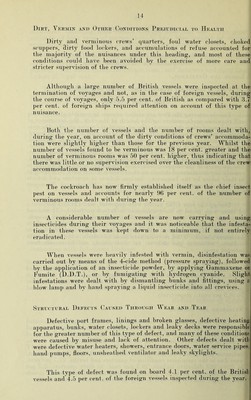
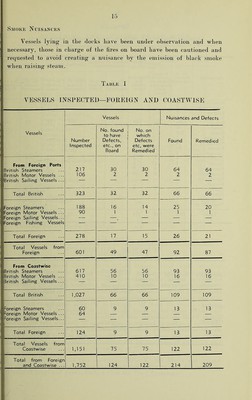
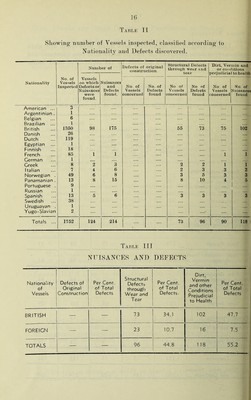
![])iRT, Ykrmin AN]) Other Oonhitions PRE.THn)i(TAL TO Health Dirty and verminous crews’ quarters, foul water closets, choked scuppers, dirty food lockers, and accumulations of refuse accounted for the majority of the nuisances under this heading-, and most of these conditions could have been avoided by the exercise of more care and stricter supervision of the crews. Although a large number of British vessels were inspected at the termination of voyages and not, as in the case of foreign vessels, during the course of voyages, only 5.5 per cent, of British as compared with 3.7 per cent, of foreign ships recjuired attention on accoimt of this type of nuisance. Both the number of vessels and the number of rooms dealt with, during the year, on account of the dirty conditions of crews’ accommoda- tion were slightly higher than those for the previous year. Whilst the number of vessels found to he verminous was 18 per cent, greater and the number of verminous rooms was 50 per cent, higher, thus indicating that there was little or no supervision exercised over the cleanliness of the crew accommodation on some vessels. The cockroach has now firmly established itself as the chief insect pest on vessels and accounts for nearly 96 per cent, of the number of verminous rooms dealt with during the year. A considerable number of vessels are now carrying and using insecticides during their voyages and it was noticeable that the infesta- tion in these vessels was kept down to a minimum, if not entirely eradicated. When vessels weie lieavily infested with vermin, disinfestation wa? carried out by means of the 4-cide method (pressure spraying), followed by the application of an insecticide powder, by applying Gammaxene oi Fumite (D.D.T.), or by fumigating with hydrogen cyanide. Slighi infestations were dealt with by dismantling bunks and fittings, using s blow lamp and bv hand spraying a liquid insecticide into all crevices. Strvc'tural Defect.s (’acsej) THR()iT(iH Wear anj) Tear Defective port frames, linings and broken glasses, defective heating! apparatus, bunks, water closets, lockers and leaky decks were responsible for the greater number of this type of defect, and many of these conditions were caused by misuse and lack of attention. Other defects dealt witli were defective water heaters, showers, entrance doors, water service pipes, hand pumps, floors, unsheathed ventilator and leaky skylights. This type of defect was found on board 4.1 per cent, of the Briti.sl: vessels and 4.5 per cent, of the foreign vessels iiispected during the year.](https://iiif.wellcomecollection.org/image/b28867476_0018.jp2/full/800%2C/0/default.jpg)