Report of the Director-General of Public Health, New South Wales.
- New South Wales. Department of Public Health
- Date:
- [1953-1957]
Licence: Public Domain Mark
Credit: Report of the Director-General of Public Health, New South Wales. Source: Wellcome Collection.
90/134 page 88
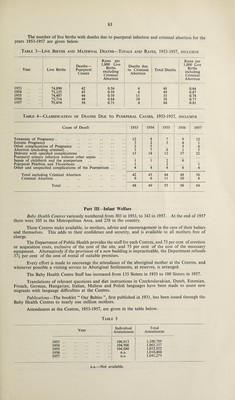
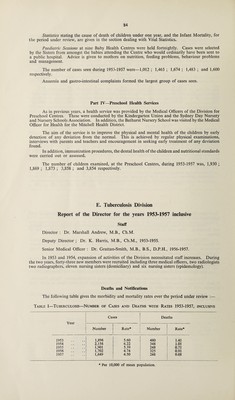
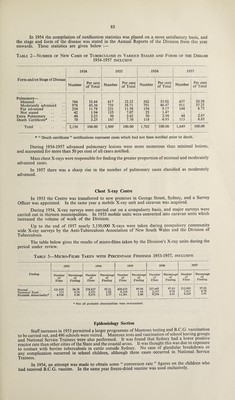
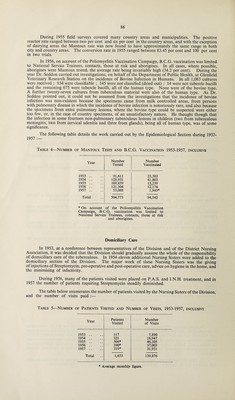
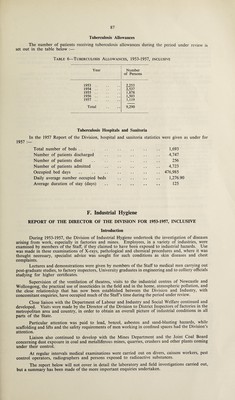
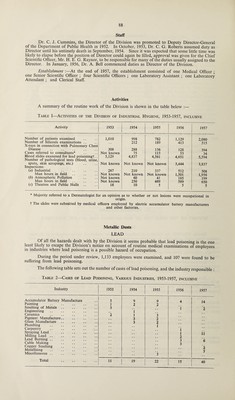
![Staff Dr. C. J. Cummins, the Director of the Division was promoted to Deputy Director-General of the Department of Public Health in 1952. In October, 1953, Dr. C. G. Roberts assumed duty as Director until his untimely death in September, 1954. Since it was expected that some little time was likely to elapse before the position of Director could again be filled, approval was given for the Chief Scientific Officer, Mr. H. E. G. Raynor, to be responsible for many of the duties usually assigned to the Director. In January, 1956, Dr. A. Bell commenced duties as Director of the Division. Establishment :—At the end of 1957, the establishment consisted of one Medical Officer ; one Senior Scientific Officer ; four Scientific Officers ; one Laboratory Assistant ; one Laboratory Attendant ; and Clerical Staff. Activities A summary of the routine work of the Division is shown in the table below :— Table I—Activities of the Division of Industrial Hygiene, 1953-1957, inclusive Activity 1953 1954 1955 1956 1957 Number of patients examined 1,010 998 782 1,129 2,080 Number of Silicosis examinations .. 212 189 413 515 X-rays in connection with Pulmonary Chest Disease 308 288 136 128 394 Cases referred to consultants* Not known 75 113 53 34 Blood slides examined for lead poisoningf.. 5,129 4,837 4,561 4,651 5,594 Number of pathological tests (blood, urine, sputa, skin scrapings, etc.) Inspections: Not known Not known Not known 3,444 3,837 (a) Industrial 267 210 337 512 508 Man hours in field Not known Not known Not known 1,501 1,956 (6) Atmospheric Pollution Not known 60 41 185 199 Man hours in field Not known 250 469 589 650 (c) Theatres and Public Halls 16 10 5 5 5 * Majority referred to a Dermatologist for an opinion as to whether or not lesions were occupational in origin. t The slides were submitted by medical officers employed by electric accumulator battery manufacturers and other factories. Metallic Dusts LEAD Of all the hazards dealt with by the Division it seems probable that lead poisoning is the one least likely to escape the Division’s notice on account of routine medical examinations of employees in industries where lead poisoning is a possible hazard of occupation. During the period under review, 1,133 employees were examined, and 107 were found to be suffering from lead poisoning. The following table sets out the number of cases of lead poisoning, and the industry responsible : Table 2—Cases of Lead Poisoning, Various Industries, 1953-1957, inclusive Industry 1953 1954 1955 1956 1957 Accumulator Battery Manufacture 5 9 9 4 14 Painting 1 2 2 Smelting of Metals 3 i 2 Engineering i Ceramics 2 1 3 Pigment Manufacture.. 3 2 * * Glass Manufacture 3 2 * * Plumbing 1 • • Carpentry i * Spraying Lead i ] ] Milling Lead .. 2 Lead Burning .. 3 6 Cable Making 3 Copper Smelting 2 Metallising 5 Miscellaneous .. 3 Total 11 19 22 15 40](https://iiif.wellcomecollection.org/image/b31485480_0090.jp2/full/800%2C/0/default.jpg)