The study of trance, muscle-reading and allied nervous phenomena in Europe and America : with a letter on the moral character of trance subjects, and a defence of Dr. Charcot / by George M. Beard.
- George Miller Beard
- Date:
- 1882
Licence: Public Domain Mark
Credit: The study of trance, muscle-reading and allied nervous phenomena in Europe and America : with a letter on the moral character of trance subjects, and a defence of Dr. Charcot / by George M. Beard. Source: Wellcome Collection.
Provider: This material has been provided by The Royal College of Surgeons of England. The original may be consulted at The Royal College of Surgeons of England.
32/40 page 32
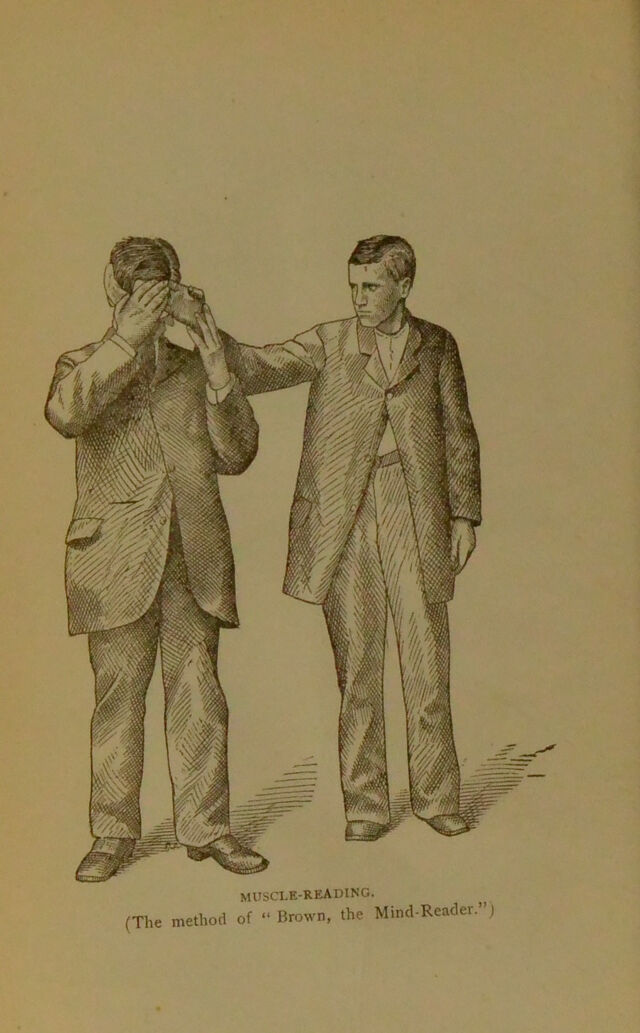
![merits, I placed a small pencil case high up in the chandelier of one of the drawing-rooms. There was first a great deal of walking about in various directions, examining tables, book shelves, etc., so that it was thought that the experiment was about to prove a failure. (It may here be mentioned parenthetically that in all the experiments tracings were taken of the routes which Mr. Bishop traversed, but it .seems needless to occupy space with recording the analysis of these results.) Then, while feeling over the surface of a table in the other drawing room, and not far from the corresjionding chandelier, Mr. Bishop suddenly pointed at arm’s length vertically to the ceiling, lie remained motion- less in this position for a few seconds, and then set off at a brisk pace in a straight line to the other drawing room, until he came beneath the other chandelier. As his linger was all this time {winting to the ceil- ing, it touched this chandelier on his coming beneath it. He then stopped and p 'inted as high as he could, but not being a tall man, was not able to touch the pencil-case, which had been purposely placed above his reach After satisfying ourselves that his determination to reach up at that particular S]X)t could not be attributed to accident, but rathef that his finger appeared to be smelling the object of his search, the experiment was concluded. As a rule, unless success is achieved within the first two or three minutes, it is never achieved at all; but in some ca.ses, as in the one just quoted, after several minutes of feeling about in various places and directions, a new point of departure seems suddenly to be taken, and Mr. Bishop starts off straight to the right spot. As an instance of thiq I may quote another experiment, in which I placed a shilling beneath a sheet of paper lying on a table which was crowded with other articles. After going alxiut the room in various directions for a considerable time, this table was reached, apparently by accident, and just at the time when I was thinking that the experiment would certainly prove a failure, Mr Bishop suddenly became more animated in his movements, and exclaiming, ‘ Now I am within two feet of it,’ began to hover the point of his finger over the table, and eventually brought it down upon the sheet of paper just where the .‘ihilling was lying beneath. “ Mr. Bishop can also very frequently localize any spot on his sub- ject’s person of which the subject may choose to think. As in all other cases, he presses the hand of the subject upon his forehead with one hand, and uses the other as a feeler. Here, again, he succeeds much better with some persons than with others, and the persons with](https://iiif.wellcomecollection.org/image/b22309615_0034.jp2/full/800%2C/0/default.jpg)