Annual report of the Medical and Sanitary Department / Sierra Leone.
- Sierra Leone. Medical and Sanitary Department
- Date:
- [1926]
Licence: Public Domain Mark
Credit: Annual report of the Medical and Sanitary Department / Sierra Leone. Source: Wellcome Collection.
55/78 page 47
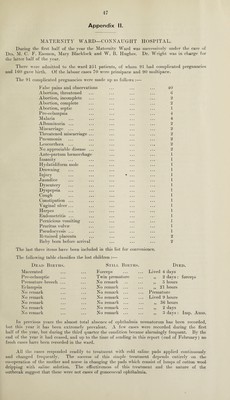
![Appendix II. MATERNITY WARD—CONNAUGHT HOSPITAL. During the first half of the year the Maternity Ward was successively under the care of Drs. M. C. F. Easmon, Mary Blacklock and W. B. Hughes. Dr. Wright was in charge for the latter half of the year. There were admitted to the ward 251 patients, of whom 91 had complicated pregnancies and 160 gave birth. Of the labour cases 70 were primiparae and 90 multiparas. The 91 complicated pregnancies were made up as follows :— False pains and observations Abortion, threatened Abortion, incomplete Abortion, complete Abortion, septic Pre-eclampsia Malaria Albuminuria ... Miscarriage Threatened miscarriage ... Pneumonia Leucorrhcea ... No appreciable disease ... Ante-partum haemorrhage Insanity Hydatidiform mole Drowning Injury ... ... ... «... Jaundice Dysentery Dyspepsia Cough Constipation ... Vaginal ulcer ... Herpes Endometritis ... Pernicious vomiting Pruritus vulva? Pseudocyesis ... Retained placenta Baby born before arrival The last three items have been included in this list for convenience. 40 6 2 2 1 4 4 2 2 2 2 2 2 1 1 1 1 1 1 ] 1 1 1 1 1 1 1 1 1 2 2 The following table classifies the lost children :— Dead Births Macerated Pre-eclamptic Premature breech . Eclampsia No remark N o remark No remark No remark N o remark Still Births. Forceps Twin premature No remark No remark ... N o remark ... No remark ... No remark ... No remark ... No remark ... Died. Lived 4 days „ 2 days : forceps „ 3 hours „ 21 hours Premature Lived 9 hours ,, 36 hours „ 2 days ,, 3 days : Imp. Anus. In previous years the almost total absence of ophthalmia neonatorum has been recorded, but this year it lias been extremely prevalent. A few cases were recorded during the first half of the year, but during the third quarter the condition became alarmingly frequent. By the end of the year it had ceased, and up to the time of sending in this report (end of February) no fresh cases have been recorded in the ward. All the cases responded readily to treatment with cold saline pads applied continuously and changed frequently. The success of this simple treatment depends entirely on the co-operation of the mother and nurse in changing the pads which consist of lumps of cotton wool dripping with saline solution. The effectiveness of this treatment and the nature of the outbreak suggest that these were not cases of gonococcal ophthalmia.](https://iiif.wellcomecollection.org/image/b31491674_0055.jp2/full/800%2C/0/default.jpg)