Licence: Public Domain Mark
Credit: Sales catalogues: Quaritch. Source: Wellcome Collection.
22/116 page 20
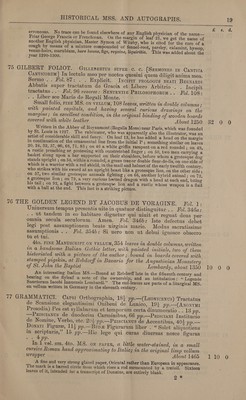
![79 GR BEATI GREGORII P.P. Small folio, MS. on vettum, by an English hand, 110 leaves, with a large initial R in gold and colours, and numerous painted capitals; hf. bd. (Reading Abbey), about 1150 A fine example of English calligraphy in the middle of the twelfth century. There is no mark in the volume to identify it with Reading, but it is evidently from the same scriptorium which produced the Gregorius elsewhere described ; and it is in the identical covering that was used for them and for all the other Reading Abbey books which came into the possession of James Bowen of Salop about 1748, and were bound for him. This volume contains thirty-nine out of the forty Homilies. It wants the fourth leaf from the beginning, and the.last two or three leaves which should comprise the fortieth Homily.—On the margin of the sixteenth leaf, in a hand of the fifteenth century, we read Mensa trapezete rutilat fulgore monete atiatan Campsor ibi mete nescia lucrum mete | ; JOD: The second line of this low Latin doggrel seems to be corrupt.—On the margin of leaf 39, in a hand of Henry VII’s time, are the words “‘ Henry per.” EGORY ON CANTICLES. Page 1: INCIPIT PROLOGUS BEATI GREGORILI PAPE SUP’ CANTICA CANTICOR’ . . Page 84: . . Hxpliciunt cantica canticorum . versus Sibille de aduentu Xpi.. Page 86: GUIGONIS PRIORIS CARTURTURIENSIS (sic) AD H. priorem DE Montz-Detr [libri tres de Vita monastica]. Page 160: Explicit liber tercius. 2 vols. in 1, sm. folio, MS. on veLLuM, beautifully written im a bold round hand, in double columns, with initials painted in red, hf. bd. About 1180-90 This is supposed to be one of the Pontigny books. It is in a very fine style of calligraphy rather resembling the work of the twelfth than of the thirteenth century; but we cannot place it earlier than the turning point, as the short final s is more frequent than the long one, and the sloped d than the upright. The second book is one of considerable celebrity in Carthusian literature, and has been the subject of much critical disputation as to its authorship. It is clear enough from the present codex that the scribes of Pontigny believed it to be the work of Guido or Guigo, General of the Carthusians, who died in 1137. However, it seems to have been proved by Mabillon that it must have been written some ten years after that date. Grecorm Pare supER HZECHIELEM PROPHETAM. Small folio, MS. on vELLUM, in a beautiful English hand, 143 leaves, written in long lines, thirty-three lines to the page; with 9 painted initials, and some pen-and-ink sketches of Saints on the margins by a fourteenth-century artist ; bd. Reading Abbey, about 1140 The last five pages are additional, and contain a story of a marvellous cure performed at Soissons by the Virgin in 1129. ‘They are not in the same hand as the rest of the book, and seem to have been written by a French monk (in Reading Abbey) soon after the date of the book. The text of the Homilies ends on the obverse of the 141st leaf—which according to an ancient numeration eught to be 145. Certainly the first two leaves are deficient. The book is a splendid example of English writing in the twelfth century; and the pen-and-ink sketches above referred to—apparently intended as cartoons for pictures—are forcibly suggestive of the state of English art in the fourteenth, James Bowen owned the volume in 1749 and had it bound. Inside the lower cover, he has caused the binder to insert, as a label, the old fourteenth-century inscription from the original cover—‘“ Hic liber est de monasterio Radyng quem qui alienaverit seu fraudem de eo fecerit anathema sit. Amen.” CESSATIONE LEGALIUM. Small folio, MS. on vettum, 30 leaves, written in an English current or charter hand, in double columns; in a seventeenth-century calf binding About 1310 A noted work on the Old and the New Law, by that famous Bishop of Lincoln who maintained the rights of the Englisa Church against the pretensions of Rome, in Henry II1’s time. oes. > Sie 1a D O APES as i | 21:0 0 3 3](https://iiif.wellcomecollection.org/image/b30857958_0022.jp2/full/800%2C/0/default.jpg)



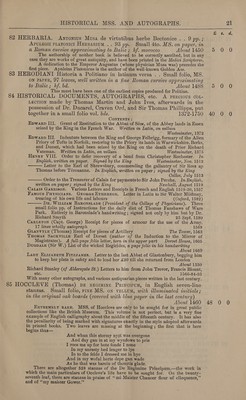

 No text description is available for this image
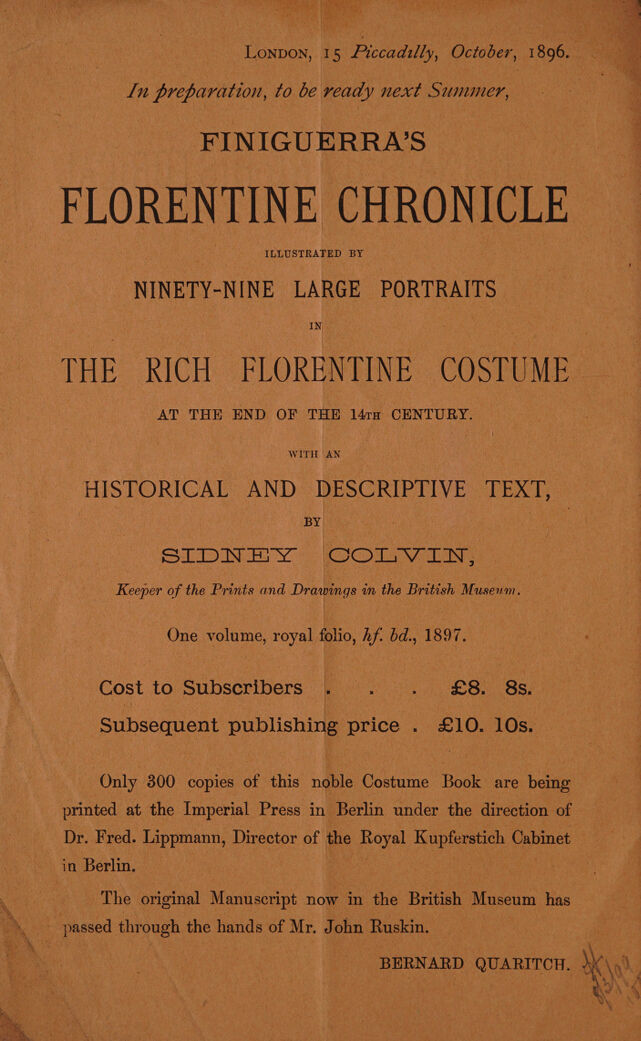 No text description is available for this image
 No text description is available for this image