Volume 2
Athenae Oxonienses. An exact history of all the writers and bishops who have had their education in the University of Oxford. To which are added the Fasti, or annals of the said university / By Anthony à Wood.
- Anthony Wood
- Date:
- 1813-1820
Licence: Public Domain Mark
Credit: Athenae Oxonienses. An exact history of all the writers and bishops who have had their education in the University of Oxford. To which are added the Fasti, or annals of the said university / By Anthony à Wood. Source: Wellcome Collection.
683/732 page 216
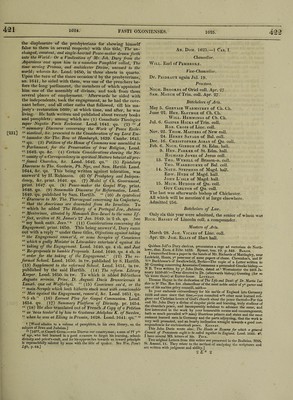
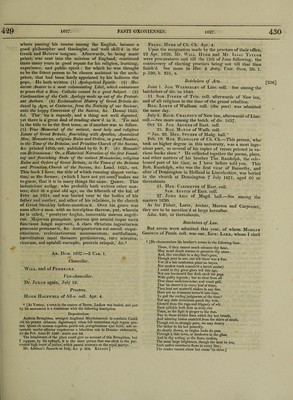
![where passing his course among the English, became a good philosopher and theologist, and well skill’d in the Greek and Hebrew tongues. Afterwards, he being made priest, was sent into the mission of England, continued there many years in good repute for his religion, learning, experience, and public spirit : for which he was thought to be the fittest person to be chosen assistant to the arch¬ priest, that had been lately appointed by his holiness the pope. He hath written (1) Apologetical Epistle. (2) Mo¬ derate Answer to a most calumniating Libel, which endeavours to prove that a Rom. Catholic cannot be a good Subject. (3) Continuation of the Cath. Apology made up out of the Protest¬ ant Authors. (4) Ecclesiastical History of Great Britain de¬ duced by Ages, or Centuries, from the Nativity of our Saviour, unto the happy Conversion of the Saxons, he. Doway 1633, fol. Tho’ ’tis a rapsody, and a thing not well digested, yet there is a great deal of reading shew'd in it. ’Tis said in the title to be the first tome, as if another was to follow. (5) True Memorial of the antient, most holy and religious Estate of Great Britain, flourishing ivith Apostles, Apostolical Men, Monasteries, religious Rules and Orders, in great Number, in the Time of the Britains, and Primitive Church of the Saxons, &c. printed 1650, oct. published by G. S. P. (6) Monasti- con Britannicum: Or, a Historical Narration of the first Found¬ ing and flourishing State of the antient Monasteries, religious Rules and Orders of Great Britain, in the Times of the Britains and Primitive Church of the Saxons, &c. Lond. 1655, oct. This book I have, the title of which running almost verba¬ tim, as the former, (which I have not yet seen) makes me to guess, that it is in many things the same. Quaere. This industrious author, who probably hath written other mat¬ ters, died in a good old age, on the fifteenth of the kal. of Febr. an. 1634, and was buried near to the bodies of his father and mother, and other of his relations, in the church of Great Steukley before-mention’d. Over his grave was soon after a mon. with an inscription thereon, put, wherein he is stiled, ( presbyter Anglus, innocentia morum angeli- cus. Majorum prosapiam, quorum ipse nemini impar sacra funetione longe superavit, & claro virtutum ingenitarum praeconio perennavit, &c. Antiquariorum sui saeculi exqui- sitissimus, ecclesiasticorum monumentum, aurifodinam, hsereditatem onmi thesauro pretiosiorem, raro scientiss, virorum, sed optabili exemplo, posteris reliquit,’ &c.4 An. Dom. 1627-—3 Car. 1. Chancellor. Will, earl of Pembroke. Vice-chancellor. Dr. Juxon again, July 19. Proctors. Hugh Halswell of All-s. coll. Apr. 4. 4 [At Versoy, a town in the canton of Berne, Ludlow was buried, and just by his monument is a tombstone with the following inscription. Depositorium. Andre® Broughton, armigeri Anglicani Maydstonensis in comitatu Cantii ubi bis preetor urbanus, dignatusque etiam fuit sententiam regis regum pro- fari. Quam ob causam expulsus patria sua, peregrinatione ejus finite, solo se- nectutis raorbo affectus requiescens a laboribus suis in Domino obdormivit, 23 die Feb. Anno D. 1687. aetatis suae 84. The inhabitants of the place could give no account of this Broughton, but I suppose, by his epitaph, it is the same person that was clerk to the pre¬ tended high court of justice, which passed sentence on the royal martyr. Mr. Addison’s Remarks on Italy, &c. p. 464. Kennet.J Franc. Hyde of Cli. Ch. Apr. 4. Upon the resignation made by the proctors of their office, 22 Apr. 1628, Mr. Will. Hyde and Mr. Isaac Taylor were procurators nati till the 13th of June following, the controversy of electing proctors being not till that time finish’d. See more in Hist. & Antiq. Univ. Oxon, lib. 1. p. 330, b. 331, a. Batchelors of Arts. June 1. Joh. Webberley of Line. coll. See among the batchelors of div. in 1640. 11. Sam. Fisher of Trin. coll, afterwards of New inn, and of all religions in the time of the grand rebellion. Rog. Lorte of Wadham coll, (the poet) was admitted the same day. July 3. Rich. Chalfout of New inn, afterwards of Line, coll.—See more among the batch, of div. 1637. Oct. 23. Joh. Archer of Exet. coll. 25. Rob. Maton of Wadh. coll. “ Jan. 26. Hen. Stubbe of Madg. hall.” Feb. 18. Rob. Randolph of Ch. Ch.—This person, who took no higher degree in this university, was a most inge¬ nious poet, as several of his copies of verses printed in va¬ rious books shew.5 He collected together the poems, plays, and other matters of his brother Tho. Randolph, the cele¬ brated poet of his time, as I have before told you. This Rob. Randolph, who was the first vicar of Barnetbv, and after of Donnington in Holland in Lincolnshire, was buried in the church at Donnington 7 July 1671, aged 60 or thereabouts. 21. Hen. Carpenter of Exet. coll. Sam. Austin of Exet. coll. 27. John Aris of Magd. hall.—See among the masters 1630. As for Fisher, Lorte, Archer, Marton and Carpenter, they are to be mention’d at large hereafter. Adm. 240, or thereabouts. Batchelors of Law. But seven were admitted this year, of whom Morgan Godwin of Pemb. coll, was one, Edw. Lake, whom I shall 5 [He characterizes his brother’s verses in the following lines: These, if they cannot much advance thy fame, May stand dumb statues to preserve thy name : And, like sun-dials to a day that’s gone. Though poor in use, can tell therehvas a Sun. Yet (if a fair confession plant no bayes, Nor modest truth conceiv’d a lavish praise) I could to thy great glory tell this age, Not one invenom’d line doth swell the page With guilty legends ; but so clear from all That shoot malicious noise, and vomit gall. That ’tis observ’d in every leaf of thine, Thou hast not scatter’d snakes in any line. Here are no remnants tortur’d into rime, To gull the reeling judgments of the time? Nor any stale reversions patch thy writ. Glean’d from the rags and frippery of wit. Each syllable doth here as truly run Thine, as the light is proper to the Sun. Nay in those feebler lines which thy last breath. And laboring brains snatch’d from the skirts of death, Though not so strongly pure, we may descry The father in his last posterity, As clearly shown, as virgins looks do pass Through a thin lawn, or shadowes in the glass. And in thy setting, as the Suns, confess. The same large brightness, though the heat be less, Such native sweetness flows in every line; The reader cannot chuse but swear’’tis thine.]](https://iiif.wellcomecollection.org/image/b30456903_0002_0683.jp2/full/800%2C/0/default.jpg)

 No text description is available for this image
 No text description is available for this image
 No text description is available for this image