[Report 1949] / Medical Officer of Health, Birkenhead County Borough.
- Birkenhead (England). County Borough Council.
- Date:
- 1949
Licence: Attribution 4.0 International (CC BY 4.0)
Credit: [Report 1949] / Medical Officer of Health, Birkenhead County Borough. Source: Wellcome Collection.
8/92 page 6
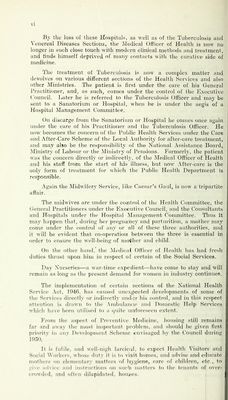
![Bv the loss of these Hospitals, as well as of the Tuberculosis and Venereal Diseases Sections, the Medical Officer of Health is now no longer in such close touch with modern clinical methods and treatment, and finds himself deprived of many contacts with the curative- side of medicine. The treatment of Tuberculosis is now a complex matter and devolves on various different sections of the Health Services and also other Ministries. The patient is first under the care of his General Practitioner, and, as such, comes under the control of the Executive Council. Later he is referred to the Tuberculosis Officer and may be sent to a Sanatorium or Hospdtal, when he is \inder the aegis of a Hospital Management Committee. On discarge from the Sanatorium or Hospital he comes once again under the care of his Practitioner and the Tuberculosis Officer. He now becomes the concern of the Public Health Services under the Care and After-Care Scheme of the Local Authority for after-care treatment, and may also be the responsibility of the National Assistance Board, .Ministry of Labour or the Ministry of Pensions. Formerly, the patient was the concern directly or indirectly, of the Medical Officer of Health and his staff from the start of his illness, but now After-care is the oidy form of treatment for which the Public Health Department is responsible. Again the Midwifery Service, like Caesar’s Gauf, is now a tripartite affair. The midwives are under the control of the Health Committee, the (General Practitioners under the Exeiiutive Council, and the Consultants and Hospitals under the Hospital Management Committee. Thus it may happen that, during her pregnancy and parturition, a mother may come under the control of any or all of these three authorities, and it will be evident that co-operation between the three is essential in order to ensure the well-being of mother and child. Gn the other hand, the .Medical Officer of Health has had fresli duties thrust upon him in respect oi certain of the Social Services. Day Nurseries—a war-time expedient—have come to stay and will remain as long .as the present demand for women in industry continues. The implementation of certain sections of the National Health Service Act, 1046, has caused unexjpected developments of some of the Services directly or indirectly uiuLfr his coTitrol, and in this respect attention is drawn to the .\mlndaiaand Domestic Help Services whidi have been utilised to a (luite ujjforeseen extent. k’roni the asf)ect of I’reventive Medicine, housing still remains far and ;iway the most iin])ortant j)r(>bleni, and should be given first prirjritv in anv Development Scheme envisaged by the CV)uncil during lOoO. It is futile, and well-nigh farcicul, to expect Health Visitors and Social \\’oi-ke)-s, whose duty it is to visit homes, and .advise and educate mothers on eh-mentary itnitters of liygi(uie, c!ire of cdiildren, etc., to vise ;id\icc end iiisl met ions on siieti mattea's to the t.('n.ants of over- crowdefl, and often dilapidated, hou^es.](https://iiif.wellcomecollection.org/image/b28927436_0010.jp2/full/800%2C/0/default.jpg)