State of the Lincoln Lunatic Asylum (instituted November 4, 1819) : [twenty-fifth report].
- Lincoln Lunatic Asylum (Lincoln, England)
- Date:
- 1849
Licence: Public Domain Mark
Credit: State of the Lincoln Lunatic Asylum (instituted November 4, 1819) : [twenty-fifth report]. Source: Wellcome Collection.
73/96 page 37
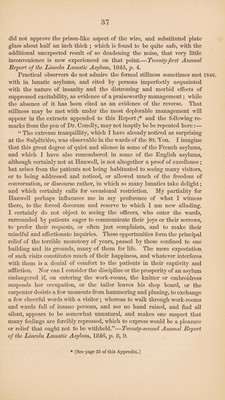
![did not approve the prison-like aspect of the wire, and substituted plate glass about half an inch thick ; which is found to be quite safe, with the additional unexpected result of so deadening the noise, that very little inconvenience is now experienced on that point.—Tiventy-first Annual Report of the Lincoln Lunatic Asylum, 1845, p. 4. Practical observers do not admire the formal stillness sometimes met 1846. with in lunatic asylums, and cited by persons imperfectly acquainted with the nature of insanity and the distressing and morbid effects of suppressed excitability, as evidence of a praiseworthy management; while the absence of it has been cited as an evidence of the reverse. That stillness may be met with under the most deplorable management will appear in the extracts appended to this Report ;* and the following re¬ marks from the pen of Dr. Conolly, may not inaptly be be repeated here :—- “ The extreme tranquillity, which I have already noticed as surprising at the Salpetriere, was observable in the wards of the St. Yon. I imagine that this great degree of quiet and silence in some of the French asylums, and which I have also remembered in some of the English asylums, although certainly not at Hanwell, is not altogether a proof of excellence ; but arises from the patients not being habituated to seeing many visitors, or to being addressed and noticed, or allowed much of the freedom of conversation, or discourse rather, in which so many lunatics take delight; and which certainly calls for occasional restriction. My partiality for Hanwell perhaps influences me in my preference of what I witness there, to the forced decorum and reserve to which I am now alluding. I certainly do not object to seeing the officers, who enter the wards, surrounded by patients eager to communicate their joys or their sorrows, to prefer their requests, or often just complaints, and to make their mindful and affectionate inquiries. These opportunities form the principal relief of the terrible monotony of years, passed by those confined to one building and its grounds, many of them for life. The mere expectation of such visits constitutes much of their happiness, and whatever interferes with them is a denial of comfort to the patients in their captivity and affliction. Nor can I consider the discipline or the prosperity of an asylum endangered if, on entering the work-rooms, the knitter or embroidress suspends her occupation, or the tailor leaves his shop board, or the carpenter desists a few moments from hammering and planing, to exchange a few cheerful words with a visitor; whereas to walk through work-rooms and wards full of insane persons, and see no hand raised, and find all silent, appears to be somewhat unnatural, and makes one suspect that many feelings are forcibly repressed, which to express would be a pleasure or relief that ought not to be withheld.”—Twenty-second Annual Report of the Lincoln Lunatic Asylum, 1846, p. 8, 9. * [See page 23 of this Appendix.]](https://iiif.wellcomecollection.org/image/b30309116_0073.jp2/full/800%2C/0/default.jpg)
 No text description is available for this image
 No text description is available for this image
 No text description is available for this image