Volume 1
Therapeutics and materia medica : a systematic treatise on the action and uses of medical agents including their description and history / by Alfred Stillé.
- Alfred Stillé
- Date:
- 1860
Licence: Public Domain Mark
Credit: Therapeutics and materia medica : a systematic treatise on the action and uses of medical agents including their description and history / by Alfred Stillé. Source: Wellcome Collection.
Provider: This material has been provided by Royal College of Physicians, London. The original may be consulted at Royal College of Physicians, London.
23/812 page 35
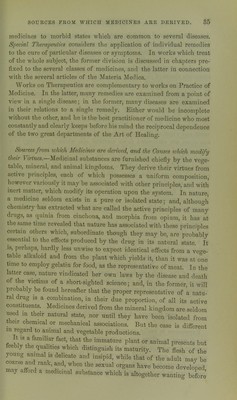
![medicines to morbid states which are common to several diseases. Special Therapeutics considers the application of individual remedies to the cure of particular diseases or symptoms. In works which treat of the whole subject, the former division is discussed in chapters pre- fixed to the several classes of medicines, and the latter in connection with the several articles of the Materia ISledica. Works on Therapeutics are complementary to works on Practice of Medicine. In the latter, many remedies are examined from a point of view in a single disease; in the former, many diseases are examined in their relations to a single remedy. Either would be incomplete wdthout the other, and he is the best practitioner of medicine who most constantly and clearly keeps before his mind the reciprocal dependence of the two great departments of the Art of Healing. Sources from which Medicines are derived, and the Causes which modify their FzV^wes.—Medicinal substances are furnished chiefly by the vege- table, mineral, and animal kingdoms. They derive their virtues from active piinciples, each of which possesses a uniform composition, however variously it may be associated with other principles, and with inert matter, which modify its operation upon the system. In nature, a medicine seldom exists in a pure or isolated state; and, although chemistry has extracted what are called the active principles of many drugs, as quinia from cinchona, and morphia from opium, it has at the same time revealed that nature has associated with these principles certain others which, subordinate though they may be, are probably essential to the effects produced by the drug in its natural state. It ]s, perhaps, hardly less unwise to expect identical effects from a vege- table alkaloid and from the plant which yields it, than it was at o°ne time to employ gelatin for food, as the representative of meat. In the latter case, nature vindicated her own laws by the disease and death of the victims of a short-sighted science; and, in the former, it will probably be found hereafter that the proper representative of a natu- ral drug is a combination, in their due proportion, of all its active constituents. Medicines derived from the mineral kingdom are seldom used in their natural state, nor until they have been isolated from _ eir chemical or mechanical associations. But the case is different in regard to animal and vegetable productions. It IS a familiar fact, that the immature plant or animal presents but eehly the qualities which distinguish its maturity. The flesh of the young animal is delicate and insipid, while that of the adult may he oarse and rank, and, when the sexual organs have become developed ay afford a medicinal substance which is altogether wanting beLe](https://iiif.wellcomecollection.org/image/b24907625_0001_0023.jp2/full/800%2C/0/default.jpg)