Volume 1
A textbook of human physiology / / translated from [the] 7th German edition by William Stirling.
- Landois, Leonard
- Date:
- 1891
Licence: Public Domain Mark
Credit: A textbook of human physiology / / translated from [the] 7th German edition by William Stirling. Source: Wellcome Collection.
Provider: This material has been provided by Royal College of Physicians, London. The original may be consulted at Royal College of Physicians, London.
42/602 (page 2)
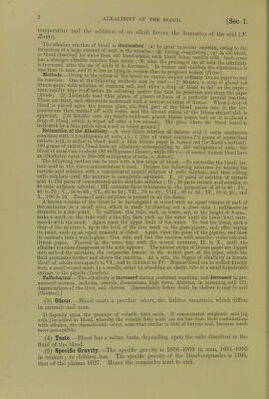
![S)atlU'e aiUl 1Ulditi°U °f m Ulkali faV0U1' th° formati°* of the acid (iV. The alkaline reaction of blood is diminished : („) bv ereat musdilfiv »™Kni, ™;„„ +~ *i formation of a large amount of acid in the muscles (/) SSfa^S^LttSr.^S' STSf WoS or blood dissolved by water from old blood-stains, such blood bein* v£2oj fid fresh cmor n^ ^r'fV 11,1U reac lon ha» ?er™ ! (8) after the prolonged use of loda he aTkaSy s ine eased, after the use of acids it is decreased. In women and children the alkalescence is leb; ™ u m*n>. anc lt+lls les,s m W-in women than in pregnant women (Pcvper). it ^Sf;~nvlllgf ?, r ?,0l0U1'01 b]00d we cannot emPloy ordinarylitmus p^-to test its reaction. One of the following methods may be used Moisten a strip of glazed red litmus paper with solution of common salt, and allow a drop of blood to fall on the paper : then rapidly wipe it off before its colouring matter has time to penetrate and tinge the paper {Zwitz). (2) Liebreich used thin plates of plaster-of-Paris of a perfectly neutial reaction. 1 hese are dried and afterwards moistened with a neutral solution of litmus. When a drop of blood is placed upon the porous plate, the fluid part of the blood passes into it, the cor- puscles are then washed off with water, and the altered colour of the litmus-stained slab is apparent. [(3) Schafer uses dry faintly-reddened glazed litmus paper, and on it is placed a drop of blood, which is wiped off after a few seconds. The place where the blood rested is indicated by a blue patch upon a red or violet ground.] Estimation of the Alkalinity. —A very dilute solution of tartaric acid (1 cubic centimetre combines with 3-1 milligrams of soda, i.e., 1 litre of water contains 7'5 grams of crystallised tartaric acid) is added to blood until a blue litmus paper is turned red (by Zuntz's method). 100 grams of rabbit's blood have an alkalinity corresponding to 150 milligrams of soda ; the blood of carnivora to about 180 milligrams (Lassar), while 100 c.c. of normal human blood have an alkalinity equal to 260-300 milligrams of soda {v. Jaksch). The following method can be used with a few drops of blood :—To neutralise the blood, tar- taric acid in the above concentration is used. Prepare the following mixtures by mixino- the tartaric acid solution with a concentrated neutral solution of sodic sulphate, and then adding sodic sulphate until the mixture is completely saturated. I., 10 parts of solution of tartaric acid to 100 parts of concentrated sodic sulphate solution ; II., 20 parts tartaric acid solution to 90 sodic sulphate solution ; III. contains these substances in the proportion of 30 to 80 ; IV 40 to 70 ; V., 50 to 60 ; VI., 60 to 50 ; VII., 70 to 40 ; VIII., 80 to 30 ; IX., 90 to 20 ; and X., 100 to 10. Excess of sodic sulphate is present in all the flasks. A known volume of the blood to be investigated is mixed with an equal volume of each of the mixtures, in a small tube, which is made by drawing out a glass tube 1 millimetre in diameter to a fine point. To calibrate this tube, suck up water, say, to the height of 8 mm., make a mark on the tube with a fine file, then suck up the water until its lower level corre- sponds with the mark. Again mark the upper limit of the water. To test the blood, suck a drop of the mixture I. up to the level of the first mark on the glass pipette, and, after wiping its point, suck up an equal quantity of blood. Again clean the point of the pipette, and blow its contents into a watch-glass ; then mix, and test the reaction with sensitive violet-coloured litmus paper. Proceed in the same way with the several mixtures, II. to X., until the alkaline reaction disappears or the acid appears. The narrow strips of litmus paper are dipped into each of the mixtures, the corpuscles remain in the wetted part of the paper, while the fluid permeates further and shows the reaction. As a rule, the degree of alkalinity in human blood of adults corresponds to VI., and in children to IV. Human blood can be sucked directly from a small wound made by a needle, either by attaching an elastic tube or a small hypodermic syringe to the pipette (Landois). Pathological.—The alkalinity is increased during persistent vomiting, and decreased in pro- nounced anremia, cachexia, ursemia, rheumatism, high fever, diabetes, in poisoning with CO, degenerations of the liver, and cholera. [Immediately before death by cholera it may be acid {Cantani).] (3) Odour.—Blood emits a peculiar odour, the halitus sanguinis, which differs in animals and man. It depends upon the presence of volatile fatty acids. If concentrated sulphuric acid [H vols.] be added to blood, whereby the volatile fatty acids are set free from their combinations with alkalies, the characteristic odour, somewhat similar to that of butyric acid, becomes much more perceptible. (4) Taste.—Blood has a saline taste, depending upon the salts dissolved in the fluid of the blood. (5) Specific Gravity.—The specific gravity is 1056-1059 in man, 1051-1055 in woman; in children less. The specific gravity of the blood-corpuscles is 1105, that of the plasma 1027. Hence the corpuscles tend to sink.](https://iiif.wellcomecollection.org/image/b24757342_0001_0042.jp2/full/800%2C/0/default.jpg)