Volume 1
A textbook of human physiology / / translated from [the] 7th German edition by William Stirling.
- Landois, Leonard
- Date:
- 1891
Licence: Public Domain Mark
Credit: A textbook of human physiology / / translated from [the] 7th German edition by William Stirling. Source: Wellcome Collection.
Provider: This material has been provided by Royal College of Physicians, London. The original may be consulted at Royal College of Physicians, London.
46/602 (page 6)
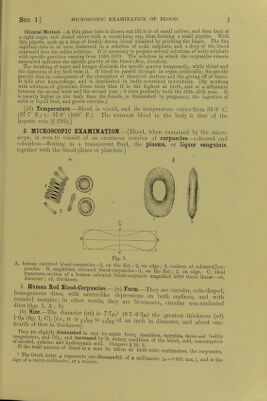
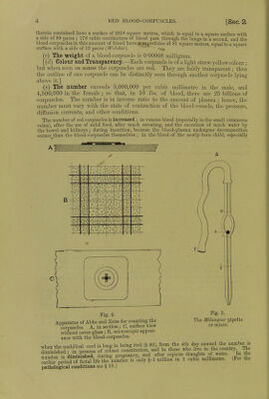
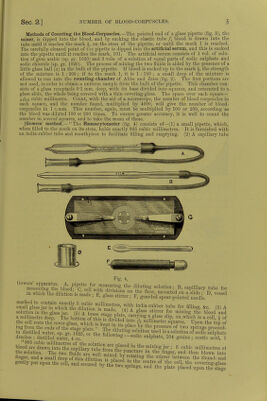
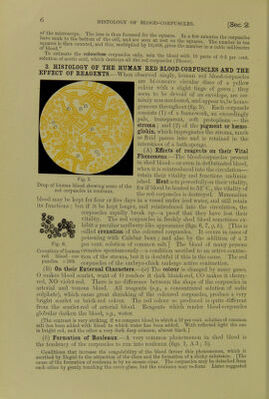
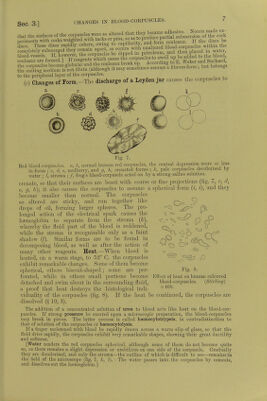
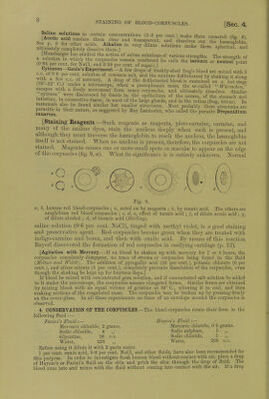
![HISTOLOGY OF BLOOD-COllPUSCLES. of the microscope. Fig. 5. Drop of human blood showing some of the red corpuscles in rouleaux. The lens is then focussed for the sauares Tn t fo«r *i i have sunk to the bottom of the ceil, and are seen at rest on flJiS^ffiSiSSS: SlSS5? thCn C°Unted' thiS' mUltiplied by 10'°00' «iV6S the -nreHnV'cVbTctiUimetre ,nW estilate..thc .colourless corpuscles only, mix the blood with 10 parts of 0'5 ner cent solution ot acetic acid, which destroys all the red corpuscles (Thoma). 1 EFFE^TOF1^^^11 w!™A? RED B^0DC0EPUSCIES AND THE EFFECT OF REAGENTS—When observed singly, human red blood-corpuscles ' are bi-concave circular discs of a yelloAv colour Avith a slight tinge of green ; they seem to be devoid of an envelope, are cer- tainly non-nucleated, and appear to,be homo- geneous throughout (fig. 5Each corpuscle consists (1) of a framework, an exceedingly pale, transparent, soft protoplasm — the stroma; and (2) of the pigment or haemo- globin, which impregnates the stroma, much as fluid passes into and is retained in the is retained m interstices of a bathTsponge. (A) Effects of reagents on their Vital Phenomena.—The blood-corpuscles present in shed blood— or even in defibrinated blood, when it is reintroduced into the circulation— retain their vitality and functions undimin- ished. Heat acts powerfully on their vitabty, for if blood be heated to 52° C, the vitality of the red corpuscles is destroyed. Mammalian blood may be kept for four or five days in a vessel under iced water, and still retain its functions; but if it be kept longer, and reintroduced into the circulation, the «corpuscles rapidly break up—a proof that they have lost their 4.^ vitality. The red corpuscles in freshly shed blood sometimes ex- hibit a peculiar mulberry-like appearance (figs. 6, 7, g, li). [This is called crenation of the coloured corpuscles. It occurs in cases of poisoning with Calabar bean; and also by the addition of a 2 per cent, solution of common salt.] The blood of many persons Crenation of human crenates spontaneously—a condition ascribed to an active contrac- red blood - cor- tion of the stroma, but it is doubtfid if this is the cause. The red puscles. x 300. corpuscles of the embryo-chick imdergo active contraction. (B) On their External Characters.—(a) The colour is changed by many gases. 0 makes blood scarlet, want of 0 renders it dark bluish-red, CO makes it cherry- red, NO violet-red. There is no difference between the shape of the corpuscles in arterial and venous blood. All reagents (e.g., a concentrated solution of sodic sidphate), which cause great shrinking of the coloured corpuscles, produce a very bright scarlet or brick-red colour. The red colour so produced is quite different from the scarlet-red of arterial blood. Reagents which render blood-corpuscles globular darken the blood, e.g., water. [The contrast is very striking, if we compare blood to which a 10 per cent, solution of common salt has been added with blood to which water has been added. With reflected light the one is bright red, and the other a very dark deep crimson, almost black.] (h) Formation of Rouleaux.—A very common phenomenon in shed blood is the tendency of the corpuscles to run into rouleaux (figs. 1, A 3 ; 5). Conditions that increase the coagulability of the blood favour this phenomenon, which is ascribed by Dogiel to the attraction of the discs and the formation of a sticky substance. [The cause of the formation of rouleaux is by no means clear. The corpuscles may be detached from each other by gently touching the cover-glass, but the rouleaux may re-form. Lister suggested](https://iiif.wellcomecollection.org/image/b24757342_0001_0046.jp2/full/800%2C/0/default.jpg)