Volume 1
A textbook of human physiology / / translated from [the] 7th German edition by William Stirling.
- Landois, Leonard
- Date:
- 1891
Licence: Public Domain Mark
Credit: A textbook of human physiology / / translated from [the] 7th German edition by William Stirling. Source: Wellcome Collection.
Provider: This material has been provided by Royal College of Physicians, London. The original may be consulted at Royal College of Physicians, London.
47/602 (page 7)
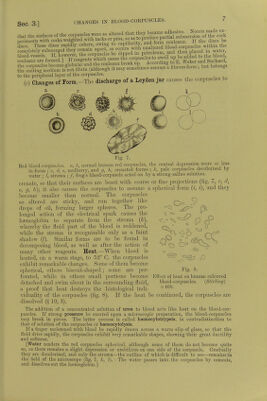
![the s»rf.r of the ^SpC^KLeS of afcS periments with corks weighted with tacks 01 pi is,, so as to proa j If the discs be to the peripheral layer of the corpuscles. (c) Changes of Form.-The discharge of a Leyden jar causes the corpuscles to k Q% 7^ o .9 o o \ .J Fig. 7. Red blood-corpuscles, a, 6, normal human red corpuscles, the central depression more or less in focus ; c, cl, e, mulberry, and g, h, crenated forms ; k, pale corpuscles decolorised by water ; I, stroma ; /, frog's blood-corpuscle acted on by a strong saline solution. eremite, so that their surfaces are beset with coarse or fine projections (fig. 7, c, d, e, g, h); it also causes the corpuscles to assume a spherical form (i, i), and they become smaller than normal. The corpuscles so altered are sticky, and run together like drops of oil, forming larger spheres. The pro- longed action of the electrical spark causes the haemoglobin to separate from the stroma (k), whereby the fluid part of the blood is reddened, while the stroma is recognisable only as a faint shadow (I). Similar forms are to be found in decomposing blood, as well as after the action of many other reagents. Heat.—When blood is heated, on a warm stage, to 52° C. the corpuscles exhibit remarkable changes. Some of them become spherical, others biscuit-shaped; some are per- forated, while in others small portions become detached and swim about in the surrounding fluid, a proof that heat destroys the histological indi- viduality of the corpuscles (fig. 8). If the heat be continued, the corpuscles are dissolved (§ 10, 3). The addition of a concentrated solution of urea to blood acts like heat on the blood-cor- puscles. If strong pressure be exerted upon a microscopic preparation, the blood-corpuscles may break in pieces. The latter process is called hsemocytotrypsis, in contradistinction to that of solution of the corpuscles or hsemocytolysis. If a finger moistened with blood be rapidly drawn across a warm slip of glass, so that the fluid dries rapidly, the corpuscles exhibit very remarkable shapes, showing their great ductility and softness. [Water renders the red corpuscles spherical, although some of them do not become quite so, as there remains a slight depression or umbilicus on one side of* the corpuscle. Gradually they are decolorised, and only the stroma—the outline of which is difficult to see—remains in the field of the microscope (fig. 7, Jc, I). The water pusses into the corpuscles by osmosis, and dissolves out the hemoglobin.] Fig. 8. Effect of heat on human coloured blood-corpuscles. {Stirling) x400.](https://iiif.wellcomecollection.org/image/b24757342_0001_0047.jp2/full/800%2C/0/default.jpg)