Volume 1
A textbook of human physiology / / translated from [the] 7th German edition by William Stirling.
- Landois, Leonard
- Date:
- 1891
Licence: Public Domain Mark
Credit: A textbook of human physiology / / translated from [the] 7th German edition by William Stirling. Source: Wellcome Collection.
Provider: This material has been provided by Royal College of Physicians, London. The original may be consulted at Royal College of Physicians, London.
49/602 (page 9)
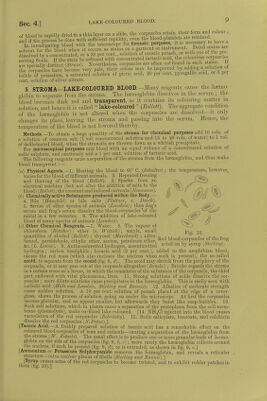
![LAKE-COLOURED BLOOD. «nlvpnr for the blood when it occurs as stains on a garment or instrument. ^IvA irTconZtnted or a 30 per cent., solution of caustic potash, or with one of the pre- Sfluids If the stain be softened with concentrated tartaric acid the colourless corpuscles ar^specillly distinct {Strum). Nevertheless, corpuscles are often not oud m BUcb tarns 1 the corpuscles have become very pale, their colour may be improved by ad ding ^ solu^r:ot iodide of potassium, a saturated solution of picric acid, 20 per cent, pyrogalhc acid, oi 3 per cent, solution of silver nitrate. 5 STROMA—LAKE-COLOURED BLOOD.—Many reagents. cause the haemo- globin to separate from the stroma. The haemoglobin dissolves in the serum ; the blood becomes dark red and transparent, as it contains its colouring matter m solution, and hence it is called lake-coloured (Rollett). The aggregate condition of the haemoglobin is not altered when the corpuscles are dissolved—it only changes its place, leaving the stroma and passing into the serum. Hence, the temperature of the blood is not lowered thereby. Methods.—To obtain a large quantity of the stroma for chemical purposes add 10 vols, of a solution of common salt (1 vol. concentrated solution and 15 to 20 vols, ot water) to 1 vol. of defibrinated blood, when the stromata are thrown down as a whitish precipitate. For microscopical purposes mix blood with an equal volume of a concentrated solution of sodic sulphate, and cautiously add a 1 per cent, solution of tartaric acid. The following reagents cause a separation of the stroma from the hfenioglobin, and thus make blood transparent :— (a) Physical Agents.—1. Heating the blood to 60° C. (Schidt:e) ; the temperature, however, varies for the blood of different animals. 2. Repeated freezing and thawing of the blood {Rollett). 3. Sparks from an electrical machine (but not after the addition of salts to the blood) {Rollett); the constant andinduced currents {Neumami), {b) Chemically active Substances produced within the Body.— 4. Bile {Hiinefeld) or bile salts {Plattner, v. Dusch). 5. Serum of other species of animals {Landois); thus dog's serum and frog's serum dissolve the blood-corpuscles of the rabbit in a few minutes. 6. The addition of lake-coloured blood of many species of animals {Landois). (c) Other Chemical Reagents.—7. Water. 8. The vapour of chloroform {Bbtlcher) ; ether {v. Wittich); amyls, small wjc ^q quantities of alcohol {Rollett) ; thymol (Marchand) ; nitro- „ , ,, , ° , c r benzol, paraldehyde, ethylic ether; aceton, petroleum ether, Rec\b ood-corpusclos of the frog &c. {L. Leivin). 9. Antimoniuretted hydrogen, arseniuretted acted 011 b>' syrup (Mtmnflf;. hydrogen; carbon bisulphide; boracic acid (2 per cent.), added to the amphibian blood, causes the red mass (which also encloses the nucleus when such is present), the so-called zooid, to separate from the oecoid (fig. 9, d). The zooid may shrink from the periphery of the corpuscle, or it may pass out of the corpuscle altogether {Briiekc) ; Briicke regards the stroma in a certain sense as a house, in which the remainder of the substance of the corpuscle, the chief part endowed with vital phenomena, lives. 11. Strong solutions of acids dissolve the cor- puscles ; more dilute solutions cause precipitates in the hfemoglobin. This is easily seen with carbolic acid {Hiils anel Landois, Stirling and Reamie). 12. Alkalies of moderate strength cause sudden solution. A 10 per cent, solution of potash placed at the edge of a cover- glass, shows the process of solution going on under the microscope. At first the corpuscles become globular, and so appear smaller, but afterwards they burst like soap-bubbles. 13. Such salt solutions, which in plants cause a separation of the protoplasm from the cell-mem- brane (plasmolysis), make ox-blood lake-coloured. [14. NH4C1 injected into the blood causes vacuolation of the red corpuscles {Bobritzky). 15. Sodic salicylate, benzoate, and colchicin dissolve the red corpuscles {N.Paton).] [Tannic Acid.—A freshly prepared solution of tannic acid has a remarkable effect on the coloured blood-corpuscles of man and animals—causing a separation of the hfemoglobin from the stroma ( W. Robert?). The usual effect is to produce one or more granular buds of hemo- globin on the side of the corpuscles (fig. 9, b, c); more rarely the hfemoglobin collects around the nucleus, if such be present (fig. 9, d), or is extruded, as shown in fig. 9, e.] [Ammonium or Potassium Sulphocyanide removes the hfemoglobin, and reveals a reticular structure—intra-miclear plexus of fibrils {Stirling and Rannic).] [Syrup causes some of the red corpuscles to become twisted, and to exhibit redder patches in them (fig. 10).] 1](https://iiif.wellcomecollection.org/image/b24757342_0001_0049.jp2/full/800%2C/0/default.jpg)