Volume 1
A textbook of human physiology / / translated from [the] 7th German edition by William Stirling.
- Landois, Leonard
- Date:
- 1891
Licence: Public Domain Mark
Credit: A textbook of human physiology / / translated from [the] 7th German edition by William Stirling. Source: Wellcome Collection.
Provider: This material has been provided by Royal College of Physicians, London. The original may be consulted at Royal College of Physicians, London.
50/602 (page 10)
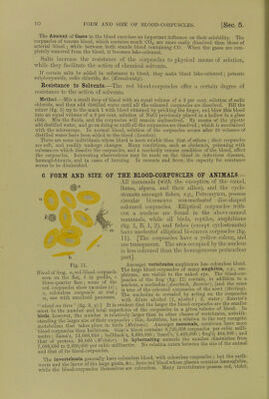
![Hie Amount of Gases in the blood exercises an important influence on their solubility. The corpuscles of venous blood, which contains much CO.,, are more easily dissolved than those of arterial blood ; while between both stands blood containing CO. When the gases are com- pletely removed from the blood, it becomes lake-coloured. Salts increase the resistance of the corpuscles to physical means of solution, -while they facilitate the action of chemical solvents. If certain salts be added in substance to blood, they make blood lake-coloured ; potassic sulphocyankle, sodic chloride, &c. (Kowalcwsky). Resistance to Solvents.—The red blood-corpuscles offer a certain degree of resistance to the action of solvents. Method.—Mix a small drop of blood with an equal volume of a 3 per cent, solution of sodic chloride, and then add distilled water until all the coloured corpuscles are dissolved. Fill the mixer (fig. 3) up to the mark 1 with blood obtained by pricking the finger, and blow this blood into an equal volume of a 3 per cent, solution of NaCl previously placed in a hollow in a glass slide. Mix the fluids, and the corpuscles will remain undissolved. By means of the pipette add distilled water, and go on doing so until all the corpuscles are dissolved ; which is ascertained with the microscope. In normal blood, solution of the corpuscles occurs after 30 volumes of distilled water have been added to the blood (Landois). There are some individuals whose blood is more soluble than that of others ; their corpuscles are soft, and readily undergo changes. Many conditions, such as choloemia, poisoniug with substances which dissolve the corpuscles, and a markedly venous condition of the blood, affect the corpuscles. Interesting observations may be made on the blood in infectious diseases, hemoglobinuria, and in cases of burning. In anemia and fever, the capacity for resistance seems to be diminished. 6. FORM AND SIZE OF THE BLOOD-CORPUSCLES OF ANIMALS.— All mammals (with the exception of the camel, llama, alpaca, and their allies), and the cyclo- stomata amongst fishes, e.g., Petromyzon, possess circular bi-concave non-nucleated disc-shaped coloured corpuscles. Elliptical corpuscles with- out a nucleus are found in the above-named mammals, while all birds, reptiles, amphibians (fig. 1, B, 1, 2), and fishes (except cyclostomata) have nucleated elliptical bi-convex corpuscles (fig. 11). [The corpuscles have a yellow colour, and are transparent. The area occupied by the nucleus is less coloured than the homogeneous perinuclear part]. Fig. 11. Blood of frog, a, red-blood corpuscle seen on the flat, b in profile, c three-quarter face ; some of the red corpuscles show vacuoles (v); ,i, colourless corpuscle at rest; //(, one with amoeboid processes. Amongst vertebrates ampliioxus has colourless blood. The large blood-corpuscles of many amphibia, e.g., atn- phiuma, are visible to the naked eye. The blood-cor- puscles of the frog (fig. 11) contain, in addition to a nucleus, a nucleolus {Aucrbacli, Ranvicr), [and the same is true of the coloured corpuscles of the newt (Stirling). The nucleolus is revealed by acting on the corpuscles with dilute alcohol (1, alcohol; 2, water; Eanvier's alcool cm tiers (fig. 9, </).] It is evident that the larger the blood-corpuscles are the smaller must be the number and total superficies of the corpuscles in a given volume of blood. In birds however, the number is relatively larger than in other classes of vertebrates, notwith- standing the larger size of their corpuscles ; this, doubtless, has a relation to the very energetic metabofism that takes place in birds (Malassez). Amongst mammals, carnivora have more blood-corpuscles than herbivora. Goafs blood contains 9,720,000 corpuscles per cubic milli- metre ; llama's, 13,000,000 ; bullfinch's, 3,600,000 ; lizard's, 1,420,000 ; frog's, 404,000 ; and that of proteus, 36,000 (Wclclcer). In hybernating animals the number diminishes fiom 7,000,000 to 2,000,000 per cubic millimetre. No relation exists between the size of the animal and that of its blood-corpuscles. The invertebrata generally have colourless blood, with colourless corpuscles ; but the earth- worm and the larva, of the large gnats, &c, have red blood whose plasma contains hemoglobin, while the blood-corpuscles themfelves are colourless. Many invertebrates possess red, violet,](https://iiif.wellcomecollection.org/image/b24757342_0001_0050.jp2/full/800%2C/0/default.jpg)