Volume 1
A textbook of human physiology / / translated from [the] 7th German edition by William Stirling.
- Landois, Leonard
- Date:
- 1891
Licence: Public Domain Mark
Credit: A textbook of human physiology / / translated from [the] 7th German edition by William Stirling. Source: Wellcome Collection.
Provider: This material has been provided by Royal College of Physicians, London. The original may be consulted at Royal College of Physicians, London.
61/602 (page 21)
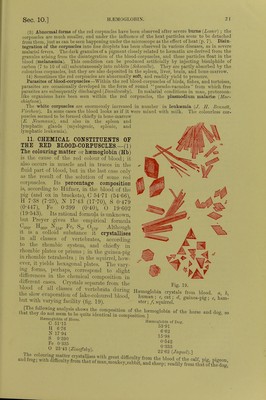
![(3) Abnormal forms of the red corpuscles have been observed after severe burns {Lesser) ; the corpuscles are much smaller, and under the influence of the heat particles seem to be detached from them, just as can be seen happening under the microscope as the effect of heat (p. 7). Disin- tegration of the corpuscles into line droplets has been observed in various diseases, as in severe malarial fevers. The dark granules of a pigment closely related to hrematin are derived from the granules arising from the disintegration of the blood-corpuscles, and these particles float in the blood (nielameniia). This condition can be produced artificially by injecting bisulphide of carbon (7 to 10 of oil) subcutaneously into rabbits {Schwalbe). They are partly absorbed by the colourless corpuscles, but they are also deposited in the spleen, liver, brain, and bone-marrow. (4) Sometimes the red corpuscles are abnormally soft, and readily yield to pressure. Parasites of blood-corpuscles—Within the red blood-corpuscles of birds, fishes, and tortoises, parasites are occasionally developed in the form of round pseudo-vacuoles from which free parasites are subsequently discharged {Danilcivsky). In malarial conditions in man, protozoon- like organisms have been seen within the red corpuscles, the Plasmodium malariae {Mar- chiafava). The white corpuscles are enormously increased in number in leukaemia {J. H. Bennett, Virehow). In some cases the blood looks as if it were mixed with milk. The colourless cor- puscles seemed to be formed chiefly in bone-marrow {E. Neumann), and also in the spleen and lymphatic glands (myelogenic, splenic, and lymphatic leukaemia). 11. CHEMICAL CONSTITUENTS OF THE RED BLOOD-CORPUSCLES.—(1) The colouring matter or haemoglobin (Hb) is the cause of the red colour of blood; it also occurs in muscle and in traces in the fluid part of blood, but in the last case only as the result of the solution of some red corpuscles. Its percentage composition is, according to Hiifner, in the blood of the pig (and ox in brackets), C 5471 (54-66), H 7-38 (7-25), N 17-43 (17-70), S 0-479 (0-447), Fe 0-399 (0-40), O 19-602 (19-543). Its rational formula is unknown, but Preyer gives the empirical formula n ^1)00' Although H960> ^154* Fe> Sg, Oirg it is a colloid substance it crystallises in all classes of vertebrates, according to the rhombic system, and chiefly in rhombic plates or prisms ; in the guinea-pig in rhombic tetrahedra ; in the squirrel, how- ever, it yields hexagonal plates. The vary- ing forms, perhaps, correspond to slight differences in the chemical composition in different cases. Crystals separate from the blood of all classes of vertebrata during the slow evaporation of lake-coloured bloodt but with varying facility (fig. 19). Fig. 19. Haemoglobin crystals from human ; c, cat; d ster; /, squirrel. blood, guinea-pig; e, a, b, ham- AtX^^^^^?*™*' S» l'?™*^ «f the „„, and dog, so entical in composition.] Hremoploljin of Doc 53-91 6-62 15-98 0-642 0-333 22-62 {Jaquel).] I he colouring matter crystallises with monkey)rabbit)ands^ Ma-moglobin of Horse. C 51-15 H 6-76 N 17-94 S 0-390 Fe 0-335 O 23-43 {Zinoffshj). and frog; with difficult calf, pig2 pigeon,](https://iiif.wellcomecollection.org/image/b24757342_0001_0061.jp2/full/800%2C/0/default.jpg)