Volume 1
A textbook of human physiology / / translated from [the] 7th German edition by William Stirling.
- Landois, Leonard
- Date:
- 1891
Licence: Public Domain Mark
Credit: A textbook of human physiology / / translated from [the] 7th German edition by William Stirling. Source: Wellcome Collection.
Provider: This material has been provided by Royal College of Physicians, London. The original may be consulted at Royal College of Physicians, London.
69/602 (page 29)
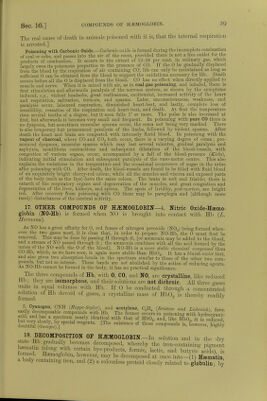
![The real cause of death in animals poisoned with it is, that the internal respiration is arrested.] Poisoning with Carbonic Oxide.—Carbonic oxide is formed during the incomplete combustion of coal or coke, and passes into the air of the room, provided there is not a free outlet for the products of combustion. It occurs to the extent of 12-28 per cent, in ordinary gas, which largely owes its poisonous properties to the presence of CO. If the 0 be gradually displaced from the blood by the respiration of air containing CO, life can only be maintained as long as sufficient 0 can be obtained from the blood to support the oxidations necessary for life. Death occurs before all the 0 is displaced from the blood. CO has no effect when directly applied to muscle and nerve. When it is mixed with air, as in coal-gas poisoning, and inhaled, there is first stimulation and afterwards paralysis of the nervous system, as shown by the symptoms induced, e.g., violent headache, great restlessness, excitement, increased activity of the heart and respiration, salivation, tremors, and spasms. Later, unconsciousness, weakness, and paralysis occur, laboured respiration, diminished heart-beat, and lastly, complete loss of sensibility, cessation of the respiration and heart-beat, and death. At first the temperature rises several tenths of a degree, but it soon falls 1° or more. The pulse is also increased at first, but afterwards it becomes very small and frequent. In poisoning with pure CO there is no dyspnoea, but sometimes muscular spasms occur, the coma not being very marked. There is also temporary but pronounced paralysis of the limbs, followed by violent spasms. After death the heart and brain are congested with intensely florid blood. In poisoning with the vapour of charcoal, where CO and CO„ both occur, there is a varying degree of coma ; pro- nounced dyspnoea, muscular spasms which may last several minutes, gradual paralysis and asphyxia, moniliform contractions and subsequent dilatation of the blood-vessels, with congestion of various organs, occur, accompanied by a fall of the blood-pressure (Klebs), indicating initial stimulation and subsequent paralysis of the vaso-motor centre. This also explains the variations in the temperature and the occasional occurrence of sugar in the urine after poisoning with CO. After death, the blood-vessels are found to be filled with fluid blood of an exquisitely bright cherry-red colour, while all the muscles and viscera and exposed parts of the body (such as the lips) have the same colour. The brain is soft and friable; there is catarrh of the respiratory organs and degeneration of the muscles, and great congestion and degeneration of the liver, kidneys, and spleen. The spots of lividity, post-mortem-, are bright red. After recovery from poisoning with CO there may be paraplegia and (although more rarely) disturbances of the cerebral activity. 17. OTHER COMPOUNDS OF HEMOGLOBIN—4. Nitric Oxide-Hemo- globin (NO-Hb) is formed when ISO is brought into contact with Hb (L. Hermann). As NO has a great affinity for 0, red fumes of nitrogen peroxide (N02) being formed when- ever the two gases meet, it is clear that, in order to prepare NO-Hb, the 0 must first be removed. This may be done by passing H through it, [or ammonia may be added to the blood, and a stream of NO passed through it; the ammonia combines with all the acid formed by the union of the NO with the 0 of the blood]. NO-Hb is a more stable chemical confound than CO-Hb, which, as we have seen, is again more stable than Hb02. It has a bhiish-violet tint, and also gives two absorption-bands in the spectrum similar to those of the other two com- pounds, but not so intense. These bands are not abolished bv the action of reducing agents. As NO-Hb cannot be formed in the body, it has no practical significance. The three compounds of Hb, with 0, CO, and NO, are crystalline, like reduced Hb ; they are isomorphous, and their solutions are not dichroic. All three erases unite in equal volumes with Hb. If 0 be conducted through a concentrated formed1 ^ ^ °f SaS6S' * CrystaUine mass of Hb02 is thereby readily «J*l C5;anogen> £NH (Boppc-Scyler), and acetylene, C2H4 {Bristoio and Licbreicli) form easily decomposable compounds with Hb. The former occurs in poisoning with hvdrocvan c a 1 and. has a spectrum nearly identical with that of HbOn, and, like HbO., it is -educed dJubtfS ttJfi 8peml reag6ntS- [The existeCe °f thfise comP°1^ howev^iy st,I8'^EC0MP?,SITI0N OF HEMOGLOBIN.—In solution and in the dry h™ f /[adually .becomes decomposed, whereby the iron-containing pigment faS? T 7tam h^°^> lactic, and butyric* acids), is formed. Hemoglobin, however, may be decomposed at once into-(l) Hsematin a body containing iron, and (2) a colourless proteid closely related to globulin- by](https://iiif.wellcomecollection.org/image/b24757342_0001_0069.jp2/full/800%2C/0/default.jpg)