Volume 1
A textbook of human physiology / / translated from [the] 7th German edition by William Stirling.
- Landois, Leonard
- Date:
- 1891
Licence: Public Domain Mark
Credit: A textbook of human physiology / / translated from [the] 7th German edition by William Stirling. Source: Wellcome Collection.
Provider: This material has been provided by Royal College of Physicians, London. The original may be consulted at Royal College of Physicians, London.
72/602 (page 32)
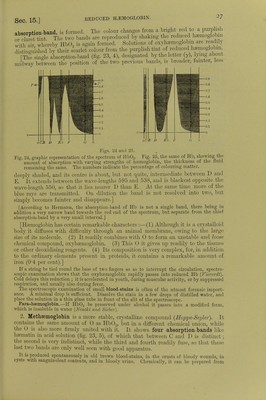
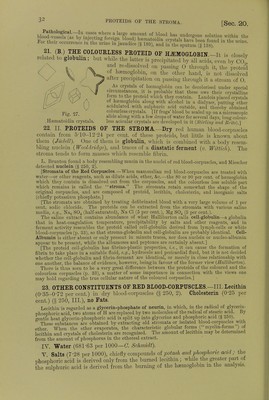
![21 (B.) THE COLOURLESS PROTEID OF HEMOGLOBIN.-It is closely related to globulin; but while the latter is precipitated by all acids, even by Col and re-dissolved on passing 0 through it, the proteid of haemoglobin, on the other hand, is not dissolved after precipitation on passing through it a stream of 0. _ As crystals of haemoglobin can be decolorised under special circumstances, it is probable that these owe their crystalline form to the proteid which they contain. Landois placed crystals of hemoglobin along with alcohol in a dialyser, putting ether acidulated, with sulphuric acid outside, and thereby obtained Ficr 27 colourless crystals. [If frogs' blood be sealed up on a microscopic slide along with a few drops of water for several days, long colour- Hiematoidin crystals. less acicular crystals are developed in it {Stirling and Brito).] 22. II. PROTEIDS OF THE STROMA.—Dry red human blood-corpuscles contain from 5-10-12-24 per cent, of these proteids, but little is known about them (Jiidell). One of them is globulin, which is combined with a body resem- bling nuclein (Wooldridge), and traces of a diastatic ferment {v. Wittich). The stroma tends to form masses which resemble fibrin. L. Brunton found a body resembling mucin in the nuclei of red blood-corpuscles, and Miescher detected nuclein (§ 250, 2). [Stromata of the Red Corpuscles.—When mammalian red blood-corpuscles are treated with water—or other reagents, such as dilute acids, ether, &c.—the 80 or 90 per cent, of haemoglobin which they contain is dissolved out from the corpuscles, and the colourless less soluble part which remains is called the stroma. The stromata retain somewhat the shape of the original corpuscles, and are composed of proteid, lecithin, cholesterin, and inorganic salts (chiefly potassium phosphate.] [The stromata are obtained by treating defibrinated blood with a very large volume of 1 per cent, sodic chloride. The proteids can be extracted from the stromata with various saline media, e.g., Na2 S04 (half-saturated), Na CI (5 per cent.), Mg S04 (5 per cent). The saline extract contains abundance of what Halliburton calls cell-globulin—a globulin that in heat-coagulation temperature, precipitability by salts and other reagents, aud in ferment activity resembles the proteid called cell-globulin derived from lymph-cells or white blood-corpuscles (p. 33), so that stroma-globulin and cell-globulin are probably identical. Cell- Albumin is either absent or only present in minute traces, nor does nuclein or nucleo-albuinin appear to be present, while the albumoses and peptones are certainly absent.] [The proteid cell-globulin has fibrino-plastic properties, i.e., it can cause the formation of fibrin to take place in a suitable fluid, e.g., hydrocele and pericardial fluid, but it is not decided whether the cell-globulin and fibrin-ferment are identical, or merely in close relationship with one another, the balance of evidence, however, being in favour of the former view (Halliburton). There is thus seen to be a very great difference between the proteids of the coloured and the colourless corpuscles (p. 33), a matter of some importance in connection with the views one may hold regarding the true cellular nature of the coloured corpuscles.] 23. OTHER CONSTITUENTS OF RED BLOOD-CORPUSCLES.—III. Lecithin (0-35-0-72 per cent.) in dry blood-corpuscles (§ 250, 2). Cholesterin (0*25 per cent.) (§ 250, III.), no Fats. Lecithin is regarded as a glycerin-phosphate of neurin, in which, in the radical of glycerin- phosphoric acid, two atoms of H are replaced by two molecules of the radical of stearic acid. By o-entle heat glycerin-phosphoric acid is split up into glycerine and phosphoric acid (§ 250). _ ° These substances are obtained by extracting old stromata or isolated blood-corpuscles with ether When the ether evaporates, the characteristic globular forms ( myelin-forms ) of lecithin and crystals of cholesterin are recognised. The amount of lecithin may be determined from the amount of phosphorus in the ethereal extract. IV. Water (681-63 per 1000—C. Schmidt). V Salts (7-28 per 1000), chiefly compounds of potash and phosphoric arid : the phosphoric acid is derived only from the burned lecithin ; while the greater part of the sulphuric acid is derived from the burning of the haemoglobin in the analysis.](https://iiif.wellcomecollection.org/image/b24757342_0001_0072.jp2/full/800%2C/0/default.jpg)