Notes on the propagation and cultivation of the medicinal Cinchonas, or Peruvian bark trees / by William Graham McIvor.
- McIvor, William Graham, -1876.
- Date:
- 1863
Licence: Public Domain Mark
Credit: Notes on the propagation and cultivation of the medicinal Cinchonas, or Peruvian bark trees / by William Graham McIvor. Source: Wellcome Collection.
23/42 page 19
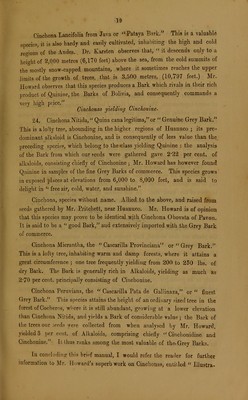
![10 Cinchona Lancifolia from Java or “Pataya Bark.” This is a valuable species, it is also hardy and easily cultivated, inhabiting the high and cold ie<^ions of the Andes.. Dr. Karsten observes that, “ it descends only to a lie^ghtof 2,000 metres (6,170 feet) above the sea, from the cold summits of the mostly snow-capped, mountains, where it sometimes reaches the upper limits of the growth of trees, that is 3,500 metres, (10,797 feet.) Mr. Howard observes that this species produces a Bark which rivals in their rich product of Quinine, the Barks of Bolivia, and consequently commands a very high price.” Cinchonas yielding Cinchonine- 'll., Cinchona Nitida, Quina cana legitima,” or “ Genuine Grey Bark.” This is a lofty tree, abounding in the higher regions of Huanuco ; its pre- dominant alkaloid is Cinchonine, and is consequently of less value than the, preceding species, which belong to the*class yielding Quinine ; the analysis of the Bark from which our seeds were gathered gave 2‘22 per cent, of alkaloids, consisting cliiefly of Cinchonine ; Mr. Howard has however found Quinine in samples of the fine Grey Barks of commerce. This species grows in exposed places at elevations from 6,000 to 8,090 feet, and is said to delight in “ free air, cold, water, and sunshine.” Cinchona, species without name. Allied to the above, and raised from seeds gathered by Mr. Pritchett, near Huanuco. Mr. Howard is of opinion that this species may prove to be identical with Cinchona Obovata of Pavon. It is said to be a “ good Bark,” and extensively imported with the Grey Bark of commerce. Cinchona Micrantha, the “ Cascarilla Provinciana” or “ Grey Bark.” This is a lofty tree, inhabiting warm and damp forests, where it attains a great circumference ; one tree frequently yieldiue: from 200 to 250 lbs. of dry Bark. The Bark is generally rich in Alkaloids, yielding as much as 2*70 per cent, principally consisting of Cinchonine. Cinchona Peruviana, the “ Cascarilla Pata de Gallinaza,” or “ finest Grey Bark.” This species attains the height of an ordinary sized tree in the forest of Cocheros, where it is still abundant, growing at a lower elevation than Cinchona Nitida, and yields a Bark of considerable value; the Bark of the trees our .^eeds were collected from when analysed by Mr. Howard, yielded 3 ]ier cent, of Alkaloids, comprising chiefly “ Cinchonidine and Cinchonine.” It thus ranks among the most valuable of the. Grey Barks. In concluding this brief manual, I would refer the reader for further information to Mr. Howard's superb work on Cinchonas, entitled Illustra-](https://iiif.wellcomecollection.org/image/b28092545_0023.jp2/full/800%2C/0/default.jpg)

 No text description is available for this image
 No text description is available for this image
 No text description is available for this image