Guide to the galleries of mammals in the Department of Zoology of the British Museum.
- British Museum (Natural History). Department of Zoology.
- Date:
- 1914
Licence: In copyright
Credit: Guide to the galleries of mammals in the Department of Zoology of the British Museum. Source: Wellcome Collection.
102/146 page 86
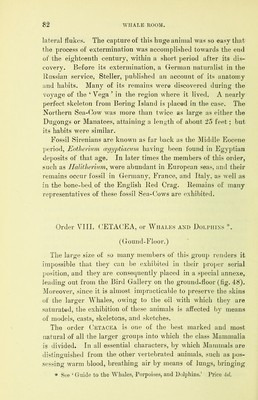
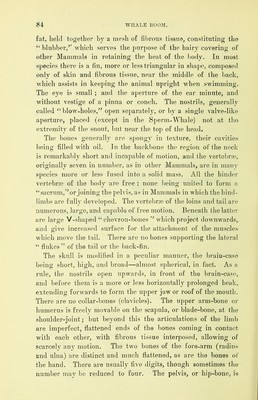
![harpoon often pierces the lungs or air-passages, and then fountains of blood inaj be forced high in the air through the blowholes, as commonly depicted in scenes of Arctic adventure; l)ut this is nothing more (allowance being made for the Whale^s peculiar mode of breathing) than what follows severe wounds of the lungs in other Mammals. AVhales and Dolphins prey upon living animal food ; but the Killer-Whales, Orca, alone eat other warm-blooded animals, as Seals, and even members of their own order, large and small. Many feed on fish, others on small floating crustaceans, minute molluscs, and jelly-fish ; while the principal food of many is constituted by various species of cuttlefishes, especially squid, which abound in some seas, where they form almost the entire support of some of the largest members of the order. In size the members of the group vary much, some of the smaller Dolphins scarcely exceeding four feet in length, while Whales are the most colossal of all animals. It is true that statements of their bulk are exaggerated, but even when reduced to their actual dimensions some of the existing Whales exceed in bulk ail animals of the present and nearly all those of past times. With some exceptions. Whales and Dolphins are timid in- offensive animals, active in their movements, and affectionate in disposition towards one another. This is especially the case with regard to the conduct of the mother towards her young, of which there is usually but one, and at most two, at a time. They are generally gregarious, swimming in herds or “ schools,’^ sometimes amounting to hundreds in number, though some species are met with singly or in ]>airs. The great commercial value of the oil which all the Cetacea yield, and the special products of certain species, such as whale- bone, spermaceti, &c., cause them to l)e subject to unremitting persecution, which has greatly diminished their numbers, and threatens some with extermination. The existing members of the order are separated into two suborders, showing important structural differences. These are the Toothed Whales or Odontoceti, and the Whalebone-Whales- or Mystacoceti.](https://iiif.wellcomecollection.org/image/b28090780_0102.jp2/full/800%2C/0/default.jpg)




 No text description is available for this image
 No text description is available for this image
 No text description is available for this image