Guide to the galleries of mammals in the Department of Zoology of the British Museum.
- British Museum (Natural History). Department of Zoology.
- Date:
- 1914
Licence: In copyright
Credit: Guide to the galleries of mammals in the Department of Zoology of the British Museum. Source: Wellcome Collection.
119/146 page 103
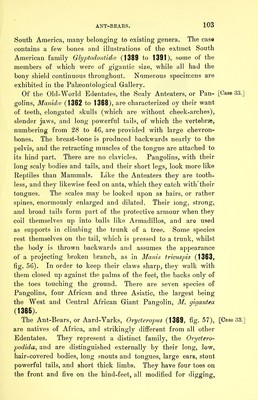
![South America, many belonging to existing genera. The case contains a few bones and illustrations of the extinct South American family Glyptodontidce (1389 to 1391), some of the members of which were of gigantic size, while all had the bony shield continuous throughout. Numerous specimens are exhibited in the Palaeontological Gallery. Of the Old-World Edentates, the Scaly Anteaters, or Pan- [Case 33.] golins, Manidce (1362 to 1368), are characterized oy their want of teeth, elongated skulls (which are without cheek-arches), slender jaws, and long powerful tails, of which the vertebrae, numbering from 28 to 46, are provided with large chevron- bones. The breast-bone is produced backwards nearly to the pelvis, and the retracting muscles of the tongue are attached to its hind part. There are no clavicles. Pangolins, with their long scaly bodies and tails, and their short legs, look more like Reptiles than Mammals. Like the Anteaters they are tooth- less, and they likewise feed on ants, which they catch with their tongues. The scales may be looked upon as hairs, or rather spines, enormously enlarged and dilated. Their long, strong, and broad tails form part of the protective armour when they coil themselves up into balls like Armadillos, and are used as supports in climbing the trunk of a tree. Some species rest themselves on the tail, which is pressed to a trunk, whilst the body is thrown backwards and assumes the appearance of a projecting broken branch, as in Manis tricuspis (1363, fig. 56). In order to keep their claws sharp, they walk with them closed up against the palms of the feet, the backs only of the toes touching the ground. There are seven species of Pangolins, four African and three Asiatic, the largest being the West and Central African Giant Pangolin, M. gigantea (1365). The Ant-Bears, or Aard-Varks, Orycteropus (1369, fig. 57), [Case 33.] are natives of Africa, and strikingly different from all other Edentates. They represent a distinct family, the Oryctero- podidce, and are distinguished externally by their long, low, hair-covered bodies, long snouts and tongues, large ears, stout powerful tails, and short thick limbs. They have four toes on the front and five on the hind-feet, all modified for digging,](https://iiif.wellcomecollection.org/image/b28090780_0119.jp2/full/800%2C/0/default.jpg)



 No text description is available for this image
 No text description is available for this image
 No text description is available for this image