Guide to the galleries of mammals in the Department of Zoology of the British Museum.
- British Museum (Natural History). Department of Zoology.
- Date:
- 1914
Licence: In copyright
Credit: Guide to the galleries of mammals in the Department of Zoology of the British Museum. Source: Wellcome Collection.
126/146 page 110
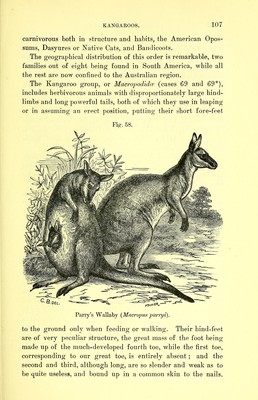
![I. C. §5 P. + M. f = 24. The incisors are large and cutting, with the enamel confined to the front surface, as in Rodents. The cheek-teeth are strongly curved, and composed of two parallel lobes each. The general form is stout and squat, and the tail rudimentary, consisting of only from 8 to 12 vertebrse, while the Phalangers have from 25 to 31. The hind-feet show a slight tendency towards the Kangaroo type of structure. Fig. 69. Coninion Wombat {Phascolomys ursinus). [Case 70.] Bandicoots, Peramelidce, are the first examples of the poly- protodont^’ carnivorous dentition, that is one with many incisors in the lower jaw, and with the lower and upper canines well developed, and suited for seizing and holding small Mammals, birds, worms, beetles, &c. The dental formula is I. f, C, ], P -f M. f = 48. On the other hand, the hind-feet show a close resemblance to those of the Kangaroos, so that these animals are in some measure intermediate between the two great groups of Marsupials. Some of the more important members of the family are the Striped Bandicoot, Perameles fasciata (1464), of Tasmania ;](https://iiif.wellcomecollection.org/image/b28090780_0126.jp2/full/800%2C/0/default.jpg)




 No text description is available for this image
 No text description is available for this image
 No text description is available for this image