Guide to the galleries of mammals in the Department of Zoology of the British Museum.
- British Museum (Natural History). Department of Zoology.
- Date:
- 1914
Licence: In copyright
Credit: Guide to the galleries of mammals in the Department of Zoology of the British Museum. Source: Wellcome Collection.
35/146 page 21
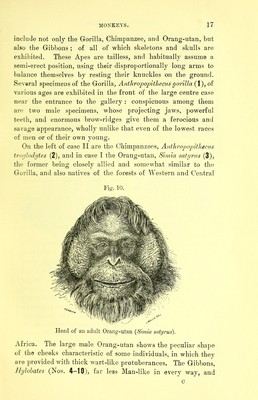
![and easily tamed, trained specimens are frequently exhibited ' alive in this country. The last family of the more typical Primates is the Hapalidce [c^se 9.] {Nos. 156-168), or Marmosets, differing from the others by the non-opposable thumb, which is provided with a claw instead of a nail, the rudimentary great toe, long, hairy, and never prehensile tail, and the different number of their teeth. They are small animals, some not exceeding a rat in size, of bright and varied appearance, many being ornamented with long tufts of hair on their ears, and all more or less brightly coloured. Marmosets are almost entirely confined to the forests of tropical South America, a single species only extending as far north as Panama. Well-known representatives are the Common Marmoset, Hapale jacclms (166), and the Pinchi, Midas cedipus (163). The second suborder of the Primates—the Lemuroidea— [Cases includes a number of Mammals of a lower type than those ^ hitherto mentioned, and for the most part natives of Madagascar, although a few are found in Africa and Southern Asia. They are almost invariably arboreal in their habits, and generally have long, bushy, and non-prehensile tails, opposable thumbs and great toes, large eyes, and long fox-like faces. From the Monkeys they differ osteologically by their longer snouts, smaller brain-cases, different dentition^ and also by the sockets of the eyes_, with one exception, being bounded on the outside only by a simple rod of bone instead of by a distinct bony wall. Among the skeletons of the genera exhibited, attention may be directed to that of Tarsius spectrum (220), remarkable for the extraordinary prolongation of the bind-foot. In this genus, as in Monkeys, the sockets of the eyes are bounded all round by a thin plate of bone, and the dentition is I. p, C. P. M. | x 2 = 34. In the Aye-aye, Chiromys madagascariensis (229), the teeth are extremely reduced in number, the formula being I. C. {J, P. J, M. I X 2 = 18. The incisors are very thick, long, curved, and without roots, as in Rodents, while the crowns of the molars are flat and smooth. The suborder is divided into families, of which the Lemuruhe contains by far the great majority of the species](https://iiif.wellcomecollection.org/image/b28090780_0035.jp2/full/800%2C/0/default.jpg)


 No text description is available for this image
 No text description is available for this image
 No text description is available for this image