Guide to the galleries of mammals in the Department of Zoology of the British Museum.
- British Museum (Natural History). Department of Zoology.
- Date:
- 1914
Licence: In copyright
Credit: Guide to the galleries of mammals in the Department of Zoology of the British Museum. Source: Wellcome Collection.
66/146 page 52
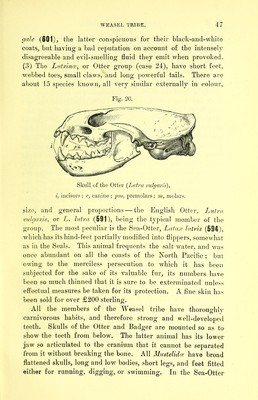
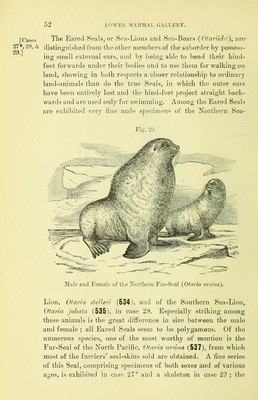
![[Cases 27*, 28, & 29.] The Eared Seals, or Sea-Lions and Sea-Bears (Otariid(e), are- distinguished from the otlier members of the suborder by possess- ing small external ears, and by being able to bend their hind- feet forwards under their bodies and to use them for walking on land, showing in both respects a closer relationship to ordinary land-animals than do the true Seals, in which the outer ears have been entirely lost and the hind-feet project straight back- wards and are used only for swimming. Among the Eared Seals are exhibited very fine male specimens of the Northern Sea- Fig-. 29. Male and Female of the Northern Fur-Seal (Ofaria ^n'sma). Lion, Otaria stelleri (534), and of the Southern Sea-Lion, Otaria juhata (535), in case 28. Especially striking among these animals is the great difference in size between the male and female ; all Eared Seals seem to be polygamous. Of the numerous species, one of the most worthy of mention is the Fur-Seal of the North Pacific, Otaria ursina (537), from which most of the furriers’ seal-skins sold are obtained. A fine series of this Seal, comprising specimens of both sexes and of various ages, is exhibited in case 27''' and a skeleton in case 29 ; the](https://iiif.wellcomecollection.org/image/b28090780_0066.jp2/full/800%2C/0/default.jpg)
 No text description is available for this image
 No text description is available for this image
 No text description is available for this image