Guide to the galleries of mammals in the Department of Zoology of the British Museum.
- British Museum (Natural History). Department of Zoology.
- Date:
- 1914
Licence: In copyright
Credit: Guide to the galleries of mammals in the Department of Zoology of the British Museum. Source: Wellcome Collection.
74/146 page 60
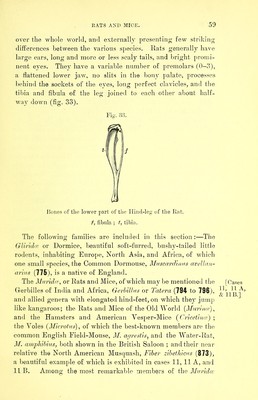
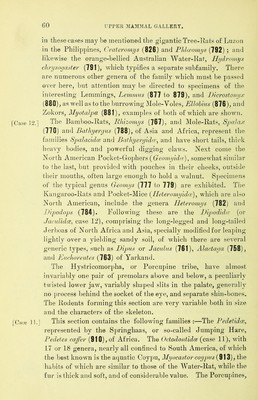
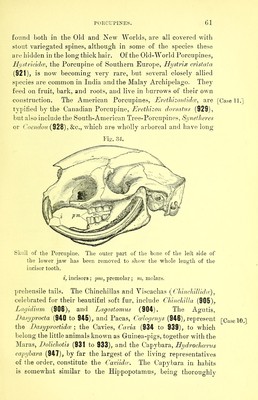
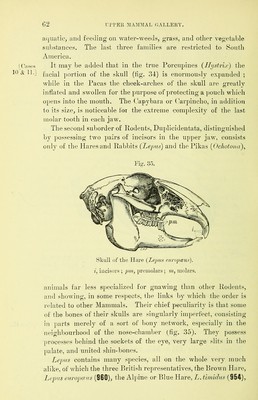
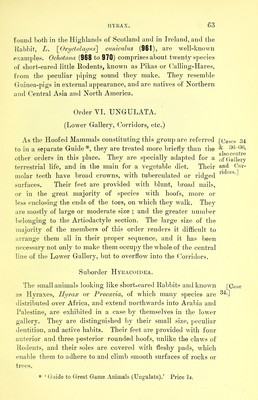
![(30 ill these cases may be mentioned tlie gigantic Tree-Eats of Luzon in the Philippines, Crateromys (826) and Pldoeomys (792) ; and likewise the orange-bellied Australian Water-Rat, Hydromys ehrysogaster (791), which typifies a separate subfamily. There are numerous other genera of the fiimily which must be passed over here, but attention may be directed to specimens of the interesting Lemmings, Lemmus (877 to 879), and iJicrostonyx (880) , as well as to the burrowing Mole-Voles, Ellohius (876), and Zokors, Myotalpa (881), examples of both of which are shown. [Casein] 'bhe Bamboo-Rats, Rldzomys (767), and Mole-Rats, (770) and Bathyergus (788), of Asia and Africa, represent the families Spalacidce and Batliyergidcv^ and have short tails, thick heavy bodies, and powerful digging claws. Next come the North American Pocket-Gophers {Geomyidcr)^ somewhat similar to the last, but provided with pouches in their cheeks, outside their mouths, often large enough to hold a walnut. Specimens of the typical genus Geomys (777 to 779) are exhibited. The Kangaroo-Rats and Pocket-Mice {Ileteromyidce)^ which are also North American, include the genera Hetevomys (782) and Dipodops (784). Following these are the Dipodidw (or Jaculidce. case 12), comprising the long-legged and long-tailed Jerboas of North Africa and Asia, specially modified for leaping lightly over a yielding sandy soil, of which there are several generic types, such as Bipus or Jacidus (761), Alactaga (758), and Emdioreutes (763) of Yarkand. The Hystricomorpha, or Porcupine tribe, have almost invariably one pair of premolars above and below, a peculiarly twisted low^er jaw, variably shaped slits in the palate, generally no process behind the socket of the eye, and separate shin-bones. The Ro(ients forming this section are very variable both in size and the characters of the skeleton. [C;i.se 11.1 This section contains the following families :—The Eedetidw, represented by the Springhaas, or so-called Jumping Hare, Pedetes cajfer (910), of Africa. The Octodontidce (case 11), with 17 or 18 genera, nearly all confined to South America, of which the best known is the aquatic Coypu, Myocastor coypus (913), the habits of which are similar to those of the Water-Rat, while the fur is thick and soft, and of considerable value. The Porcupines,](https://iiif.wellcomecollection.org/image/b28090780_0074.jp2/full/800%2C/0/default.jpg)
 No text description is available for this image
 No text description is available for this image
 No text description is available for this image