Guide to the galleries of mammals in the Department of Zoology of the British Museum.
- British Museum (Natural History). Department of Zoology.
- Date:
- 1914
Licence: In copyright
Credit: Guide to the galleries of mammals in the Department of Zoology of the British Museum. Source: Wellcome Collection.
81/146 page 67
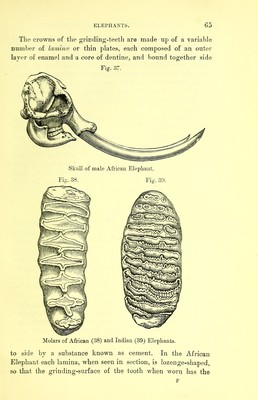
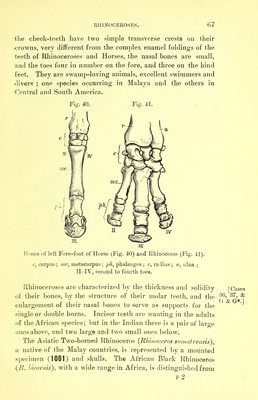
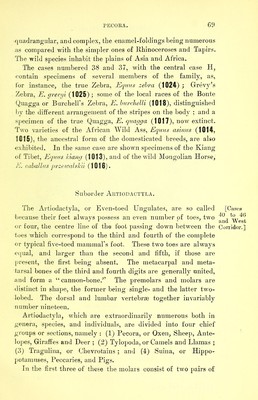
![RHINOCEROSES. C)7 +he cheek-teeth have two simple transverse crests on their crowns, very different from the complex enamel foldinos of the teeth of E/hinoceroses and Horses, the nasal bones are small, and the toes four in number on the fore, and three on the hind feet. They are swamp-loving animals, excellent swimmers and divers ; one species occurring in Malaya and the others in Central and South America. Fig-. 40. Fig. 41. HI Hones of left Fore-foot of Horse (Fig. 40) and llliinoceros (Fig. 41). c, carpus; me, metacarpus ; ph, phalanges ; r, ra-Iius ; u, ulna ; II-IV, second to fourth toes. Rhinoceroses are characterized by the thickness and solidity of their bones, by the structure of their molar teeth, and the enlargement of their nasal bones to serve as supports for the single or double horns. Incisor teeth are wanting in the adults of the African species; but in the Indian there is a pair of large ones above, and two large and two small ones below. The Asiatic Two-horned Rhinoceros [Rhinoceros sumatrensis), a native of the Malay countries, is represented by a mounted specimen (toot ) and skulls. The African Black Rhinoceros (R. hicornis), with a wide range in Africa, is distinguished from [Oases .36, 37, & G & G^.]](https://iiif.wellcomecollection.org/image/b28090780_0081.jp2/full/800%2C/0/default.jpg)
 No text description is available for this image
 No text description is available for this image
 No text description is available for this image