The horse-hoing husbandry: or, an essay on the principles of tillage and vegetation ... Wherein is shewn a method of introducing a sort of vineyard-culture into the corn-fields, in order to increase their product, and diminish the common expence; by the use of instruments described in cuts / By I.T. [J. Tull].
- Jethro Tull
- Date:
- 1733
Licence: Public Domain Mark
Credit: The horse-hoing husbandry: or, an essay on the principles of tillage and vegetation ... Wherein is shewn a method of introducing a sort of vineyard-culture into the corn-fields, in order to increase their product, and diminish the common expence; by the use of instruments described in cuts / By I.T. [J. Tull]. Source: Wellcome Collection.
244/318 (page 212)
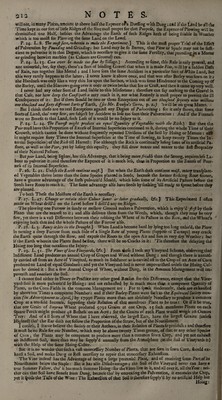
![Will not, in many Places, amount tp above half the Expence of a D refling with Dung; and if1 the Land be all the Time kept in our fort of little Ridges of the Size moil proper for that Purpofe, the Expence of Plowing will be deminiihed One Half, befides the Advantage the Earth of fuch Ridges hath of being friable in Weather which is too moift for Plowing the fame Land on the Level. P. 24. L. 8. The mojl fare, wherein to make the ExperimentThis is the moil proper Trial of the EfFedl t>f Pulveration by Pounding and Grinding', but Land may be fo Barren, that Plow or Spade may not be fuffi- cient to pulverise it to that Degree, which is neceifary to give it the fame Fertility, that pounding in a Morter or grinding betwixt marbles (as Colours are Ground) can. P.24. L. 13. Can ever he made too fine by Tillage.'] According to fome, this Rule is only general, and not univerial; for, fay they, there’s a Sort of binding Gravel that when it is made Fine, will by a hidden Dafh of Rain, run together like Mettal ; and I have feen the fame Accident in a particular Sort of White Land, but this very rarely happens to the latter; I never knew it above once, and that was after Barley was fown on it; the Hardnefs was only like a very thin Ice upon the Surface, which was fome Hindrance to the Coming up df the Barley, until the Harrows going over it onpe or twice broke that Ice or Cruft, and then it came up very well. I never had any other Sort of Land liable to this Misfortune ; therefore can fay nothing to the Gravel in that Cafe, nor how deep the ConJlipatUn may reach in it, nor what Remedy is moft proper to prevent the ill Confequence of it: But if there ihould be two or three Exceptions out of one. thoufand feyenty nine millions one thoufand and Jixty different Sorts of Earth, (fee Mr. Evelyn s Terra, p. 2.) ’twill be no great Matter. But I think thefe are no real Exceptions againft any Degree of Pulverizing ; for it only fhevvs, that fome Sorts of Land, tho’ very few, are fubjeil by Accident to lofe too foon their Pulveration : And if the Finenefs Were no Benefit to that Land, fuch Lofs of it would be no Injury to it. P. 24. L. 24. The Poorejl might produce an equal Quantity cf Vegetables vuith the Rich,] But then the Prarmuft have this Proportion of Excefs of Internal Superficies continued to it, during the whole Time of their Growth, which cannot be done without frequently repeated Divifions of the Soil by Hoing or Manure; elie it might require forty Times the Internal Superficies at the Time of Sowing, to keep twenty Times the In¬ ternal Superficies) of the Rich till Harveft: For although the Rich is continually lofing fome of its artificial Pa¬ fture, as well as the Poor, yet by lofing this equally, they ftill draw nearer and nearer to the firft Inequality of their Natural Pafture. But poor Land, being lighter, has this Advantage, that it being more friable than the Strong, requires lefs La¬ bour to pulverize it; and therefore the Expence of it is much lefs, tha*i in Proportion to the Excefs of Poor- nefs of its Internal Superficies. P, 26. L. 21. Unlejs the Earth continue moijl.'] But when the Earth doth continue moift, many tranfplant- ed Vegetables thrive better than the fame Species planted in Seeds, becaufe the former ftriking Root fooner, have a greater advantage of the freih pulveriz’d Mould, which lofes fome of its Artificial Palture before the Seeds have Roots to reach it. The fame advantage alfo have Seeds by foaking ’till ready to fprout before they afe planted. To both Thefe the Moifture of the Earth is neceifary. P.2“. L. 47. Change or retain their Colour fooner or later gradually, &c.] This Experiment I often made on Wheat drill’d on the Level before I drill’d any on Ridges. The plowing one Furrow in fandy or mellow Ground makes a Pulveration, which is enjoy’d firji by thofe Plants that are the neareft to it; and alfo delivers them from the Weeds, which, though they may be very few, yet there is a vaft Difference between their robbing the Wheat of its Pafture in the Row, atid the Wheat’s enjoying both that and the whole Pafture of the Furrow alfo. P.28. L. 3. Fancy it lets in the Drought.J When Land is become hard by lying too long unho’d, the Plow 5n turning a deep Furrow from each Side of a Single Row of young Plants (fuppofe of Turneps) may crack the Earth quite through the Row, and expofe the Roots to the open Air and Sun in very dry Weather; but if the Earth wherein the Plants ftand be fine, there will be no Cracks in it: ’Tis therefore the delaying the Hoing too long that occafions the Injury. P.29. L. 51. The Vines oflow Vineyards, (ffc.] From thefe I took my Vineyard Scheme, obferving that indifferent Land produces an annual Crop of Grapes and Wood without Dung ; and though there is annual¬ ly carried oft from an Acre of Vineyard, as much in Subftance as is carried oft in the Crop of an Acre of Corn produced on Land of equal Goodnefs; and yet the Vineyard-Soil is never impoverifhed unlefs the Hoing Cul¬ ture be denied it : But a few Annual Crops of Wheat, without Dung, in the dbmmon Management will im- poverifh and emaciate the Soil. I cannot find either in Theory or Practice any other good Reafort for this Difference, except that the Vine' yard-Soil is more pulveriz’d by Hoing; and not exhaufted by fo much more thaji a competent Quantity of Plants, as the Corn-Fields in the common Management are : For to fpeak moderately, thefe are exhaufted by above ten Times a competent Number; and if their Barley-Plants were fuch as the Equivocal Society men¬ tion (in Advertifement to April,) by 17990 Plants more than are abfolutely Neceffary to produce a common Crop at a ten-fold Increafe, fuppofing their Relation of that monftrous Plant to be true: Or if it be true, that one Grain of Smyrna Wheat produced 9792 Grains at one Crop, 15 fuch monftrous Plants on each Lquare Perch might produce 48 Bufhels on an Acre; for the Grains of each Plant would weigh 26 Ounces Troy: And of a 11 Sorts of Wheat that I have obietved, the largeftEars, have the largeft Grains (unlefs blighted) tho’ the Ear doth not follow the Proportion of the Straw, but of the Nouriihment. I confefs, I fcarce believe the Society or their Authors, in their Relation of Plants fo prolifick; and therefore it muft be no Rule for our Number, which may be above twenty Times greater, of that or any other Species of Corn the Plants may be competent to produce more than a common fown Crop, and yet not exhauft an indifferent Soil, more than may be fupply’d annually from the Atmofphere (as the Soil of Vineyards is) with the Help of the fame Hoing-Culter. But it is no wonder that fuch a vaft unneceflary Number of Plants, that are feen in fown Corn, ihould ex¬ hauft a Soil, and make Dung or Reft neceifary to repair that unneceflary Exhauftion. The Vine indeed has the Advantage of being a large perennial Plant, and of receiving fome Part of its Nouriihment below the Staple: But it has alfo Difadvantages; the Soil of the Vineyard never can have* true Summer Fallow, tho’ it has much Summer Hoing: for theVines live in it, and all over it, alltheYear: nei¬ ther can that Soil have Benefit from Dung, becaufe tho’ by encreaiing the Pulveration, it encreafes the Crop, yet it ipoils the Talk of the Wine; The Exhauftion of that Soil is therefore fupply’d by no artificial Help but Hoing:](https://iiif.wellcomecollection.org/image/b30408295_0244.jp2/full/800%2C/0/default.jpg)