Annual report of the General Board of Commissioners in Lunacy for Scotland : 16th 1874
- Great Britain. General Board of Commissioners in Lunacy for Scotland.
- Date:
- 1874
Licence: Public Domain Mark
Credit: Annual report of the General Board of Commissioners in Lunacy for Scotland : 16th 1874. Source: Wellcome Collection.
343/356 (page 323)
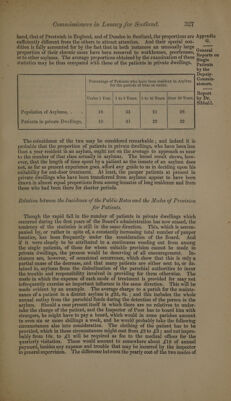
![v4 Commissioners in Lunacy for Scotland. - 323). = mental condition. The fits are frequent and sometimes recur rapidly, and Appendix -at his best he seldom passes a day altogether free from them. In November 1872 he fell into the fire during an attack, and he was left in contact with the burning fuel long enough to have his hands severely injured. The thumb General of one hand is in consequence now glued close to the forefinger. At the time Reports on of the accident he had been left under charge of a girl, who might easily have pee ; saved him from serious injury, but she was so stupid that she ran out of the ee ia i house to get some one to help him out of the fire, instead of lifting him herself. yonttiel The house is situated in a remote part of the parish, and the medical officer was Gommis- not informed of the accident till a month after it had happened. The guardian gioners. and his household seem kindly disposed people, but wanting in energy and intelligence. The worst features of the case, however, are due to the difficulty Report of exercising due supervision, or rendering such aid as may be necessary, at such by Dr. a distance from any centre of population. The periodical visits of the medica] Sibbald. officer, which ought to be paid independently of any special medical necessities, and which are unusually important in such a case as this, had been somewhat neglected. It was thought sufficient to require his removal to a less remote habitation, and to call the attention of the medical officer to the necessity of more regular supervision in future. The last of the four cases in the Highland district is that of J. M‘M. He is a weak-minded person who had received an education intended to enable him to join a learned profession. But whether from having overtasked his powers, or from the breakdown of a mental organisation never strong enough to struggle through the passage into early manhood, he had an attack of acute insanity before he passed through the curriculum of study, and has never been able to apply himself steadily to any useful occupation since. His chief mental characteristic is an overweening belief in his own extraordinary literary power and religious knowledge. He was once for a few months in the district asylum, and improved very much while there; and there is little doubt that if boarded in a private household, under moderately judicious guardianship, he would easily be kept in a satisfactory condition. But unfortunately he lives with his parents, who are not very intelligent ; and are infatuated enough to regard the mental eccentricities and weaknesses of their son as proofs of his extra- ordinary genius. The result is that he is encouraged in the indulgence of his love for scribbling and accumulating useless manuscript, to the neglect of personal cleanliness, and of all occupation which might improve either physical or mental health. The evil tendency of all this has been strongly urged on the attention of the parents and Parochial authorities, whenever he has been visited; but no improvement can be expected so long as he lives in his father’s house. Removal _to other guardianship has accordingly been recommended; but there does not seem to be much prospect of this course being followed, It is indeed generally difficult and not often desirable to place a pauper lunatic who has been accustomed to live with his parents under the guardianship of a stranger, so long at least as the parents are anxious that he should stay withthem. The reasons for such a course must be strong in any case, and in the case under consideration there is an ad- ditional and almost insuperable obstacle to removal presented by the circumstance that the patient’s father only receives a small allowance from the Parochial Board towards the support of his son. That is to say, the father contributes materially towards the expense of maintenance, and thereby acquires an additional claim to a voice in determining the mode of provision. And though a change would probably be beneficial to the son, it would be not improbably injurious to the parents, whose errors are rather due to a morbidly exaggerated affection than to any strictly blameworthy disposition. This case affords a good illustra- tion of the way in which the existence of family bonds often frustrates the desire of the Board to benefit those under its jurisdiction. be aris The case of C. N., in the Lowland Manufacturing district, is another illustration of the same difficulty—a harmless imbecile living with a useless intemperate mother. Here, however, the Parochial authorities have hitherto made no attempt to improve the condition of the patient ; and the Board has intimated that unless this is decidedly improved before next visit, removal to the asylum will be insisted on. The only other case reported as bad is that of T. C., an epileptic idiot boarded with his sister. In consequence of my report after the last visit he has](https://iiif.wellcomecollection.org/image/b31856342_0343.jp2/full/800%2C/0/default.jpg)