Annual report of the General Board of Commissioners in Lunacy for Scotland : 16th 1874
- Great Britain. General Board of Commissioners in Lunacy for Scotland.
- Date:
- 1874
Licence: Public Domain Mark
Credit: Annual report of the General Board of Commissioners in Lunacy for Scotland : 16th 1874. Source: Wellcome Collection.
345/356 (page 325)
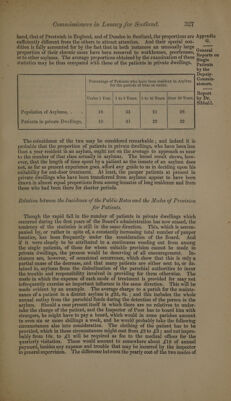
![/ t - Commissioners in Lunacy for Scotland. 325 latter 30 per cent. The largest proportion of chronic cases, and the smallest propor- tion of congenital, occurs in the Lowland Manufacturing District ; the chief cause of this peculiarity being the existence in that district of the villages of Kennoway and Star to which so many patients have been transferred from Edinburgh Asylums. insanity ; almost all the rest are subjects of long-¢ontinued chronic insanity. Proportion of Patients in Private Dwellings who have been previously Inmates of Asylums. The number who have previously been resident in asylums ought also to be taken into consideration in any discussion of the cases here reported on. It would be both interesting and useful to ascertain whether the proportion of those who have undergone treatment in asylums is increasing, and whether such increase is likely to continue. At present this can best be done by examining such a table as the statistics for 13 years give at page 314 of this report. We there find that there has been of late years an annually increasing number of patients transferred from asylums to private dwellings. In 1864 only 34 patients were thus trans- ferred, but the number has steadily increased, till in 1872 there were 96. This remarkable increase in what may be called the indirect additions to the number of patients not in asylums, has however been accompanied by as remarkable a decrease in the direct additions to the roll. In 1864 these amounted to 110, and in 1872 to only 68. We thus find that assuming the same proportion of re- coveries, discharges, removals to asylums, and deaths, to occur in each class, a long continuance of the relative proportions of direct and indirect additions which existed in 1864 would result ultimately in a total number consisting of about 76 per cent. of patients who had been directly admitted to the roll, and 24 per cent. who had been transferred from asylums. If again the proportions found in the additions for 1872 were to be permanently maintained, there would be only 41 per cent. who had been directly added to the roll, against 59 per cent. of transfers from asylums. We arejustified in concluding that the tendency of the influences at present at work is to produce a relative proportion of each class more and more resembling what was shown in the additions to the roll during the more recent period. I am not aware, however, that any census of the patients has hitherto been recorded in which this point has been illustrated ; and the deductions which can be drawn from a single inquiry, without an opportunity of comparing its results with those of previous investigations, must necessarily be very imperfect. The following table shows the relative proportions of the two classes for the past year :— TABLE SHOWING THE NUMBER oF PATIENTS WHO HAVE BEEN IN ASYLUMS, AND THE PERIODS SINCE THEIR DISCHARGE. Period since Discharge E of those who have ; >, | been previously under Proportion per Cent. of cach Class. 4 a Asylum Treatment. DISTRICTS sal 3 a/#|% - Eg eel S| 2| s| 8/8 $j)4|)38)8 eel mei gs] es] s Never [Ri eine ie} a ne ci 4 = = under 4 rm cults ia > ie eee ee a Asylum. | &i 6 | Poh sg 7 zs! es! e s Treatment.) 3] 9 | S =) 4 Yo) ro PlAlwowlo Insular, . F i Bae aaniee Lee Btn de hi Bee 99 PS es ey Highland, . . .| 178/21 | 25|10| 8 | 242] 74 g| 10] 4 Lowland Manufacturing, 116} 19 | 43 | 13 | 18 | 209 55 9| 21] 6 Southern Agricultural, | 79) 1|10] 9] 5/| 104) 76 Tyo Borda eet ert ate f sh a lah gr hake qa 5 Le ea 7 ae 35 | 682 71 | 7 12 Z Appendix General Reports on - Single Patients by the Deputy- Commis- sioners. Report by Dr. Sibbald.](https://iiif.wellcomecollection.org/image/b31856342_0345.jp2/full/800%2C/0/default.jpg)