Annual report of the General Board of Commissioners in Lunacy for Scotland : 16th 1874
- Great Britain. General Board of Commissioners in Lunacy for Scotland.
- Date:
- 1874
Licence: Public Domain Mark
Credit: Annual report of the General Board of Commissioners in Lunacy for Scotland : 16th 1874. Source: Wellcome Collection.
346/356 (page 326)
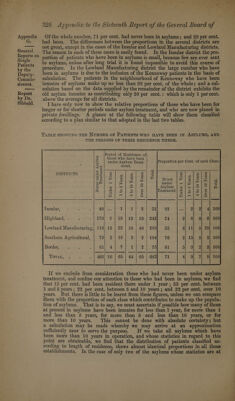
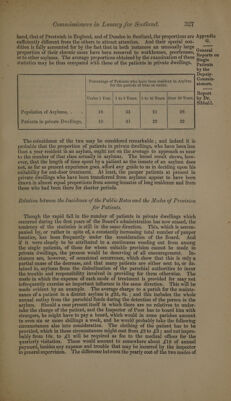
![G. General Reports on Single Patients by the Deputy- Commis- sioners. Report by Dr. Sibbald. 326 Appendix to the Sixteenth Report of the General Board of | had been. ‘The differences between the proportions in the several districts are not great, except in the cases of the Insular and Lowland Manufacturing districts. The reason in each of these cases is easily found. In the Insular district the pro- portion of patients who have been in asylums is small, because few are ever sent to asylums, unless after long trial it is found impossible to avoid this course of procedure. In the Lowland Manufacturing district the large number who have been in asylums is due to the inclusion of the Kennoway patients in the basis of calculation. The patients in the neighbourhood of Kennoway who have been inmates of asylums make up no less than 92 per cent. of the whole; and a cal- culation based on the data supplied by the remainder of the district exhibits the old asylum inmates as contributing only 30 per cent.: which is only 1 per cent. above the average for all districts. I have only now to show the relative proportions of those who have been for longer or for shorter periods under asylum treatment, and who are now placed in private dwellings. A glance at the following table will show them classified according to a plan similar to that adopted in the last two tables. TABLE SHOWING THE NUMBER OF PATIENTS WHO HAVE BEEN IN ASYLUMS, AND THE PERIODS OF THEIR RESIDENCE THERE, those who have been = =I under Asylum Treat- Proportion per Cent. of each Class. ae ment. ISTRICTS gal 4 ee : Sots DISTRICTS. os & os wa 5 § 4 ‘Ss =| BS| me] 3] 8 he Never | >| & & Oy BA] va 4 ° under riplole iS iy 10 a Um Asylum | #} wo [a] 7 A 1 Sok 5 Treatment. sis|/8 S 1] faded hed ty tO A Insular, Highland, . Lowland Manufacturing, Southern Agricultural, Border, Torat, If we exclude from consideration those who had never been under asylum treatment, and confine our attention to those who had been in asylums, we find that 13 per cent. had been resident there under 1 year; 33 per cent. between 1 and 5 years ; 22 per cent. between 5 and 10 years; and 32 per cent, over 10 years. But there is little to be learnt from these figures, unless we can compare them with the proportion of each class which contributes to make up the popula- tion of asylums. That is to say, we must ascertain if possible how many of those at present in asylums have been inmates for less than 1 year, for more than 1 and less than 5 years, for more than 5 and less than 10 years, or for more than 10 years. This cannot be done with absolute certainty; but sufficiently near to serve the purpose. If we take all asylums which have been more than 10 years in operation, and whose statistics in regard to this point are obtainable, we find that the distribution of patients classified ac- cording to length of residence, shows almost identical proportions in all these establishments. In the case of only two of the asylums whose statistics are at](https://iiif.wellcomecollection.org/image/b31856342_0346.jp2/full/800%2C/0/default.jpg)