Administration report / Public Health Department, Colombo Municipality.
- Colombo (Sri Lanka). Public Health Department
- Date:
- [1917]
Licence: Public Domain Mark
Credit: Administration report / Public Health Department, Colombo Municipality. Source: Wellcome Collection.
20/60 (page 10)
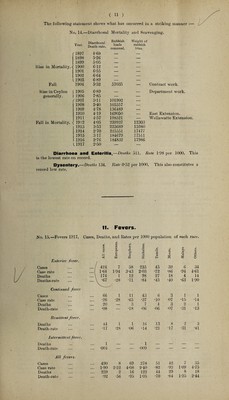
![No. ]2.—Death-rate from Pulmonary Diseases in 1909 and 1917. Calculated on Census population 1911. MALES. FEMALES. r • --- Race. 1909. 1917. Reduction. 1909. 1917. Reduction. Burghers ... 756 ... 7-51 0‘05 9-12 ... 6*89 2-23 Sinhalese ... 11A9 ... 7-08 441 11*23 ... 8-16 307 Moors ... 1026 ... 3-89 6 37 13-59 ... 5-72 7-89 Malays 9-45 ... 6-70 2-75 15*06 ... 989 547 All races ... 11*39 ... 6‘19 5*20 11*96 ... 7*69 4*27 The improvement recorded above in the case especially of the Mohamedan females is very encouraging. Pneumonia.—Deaths 654. Rate 2 53 per 1,000. The death-rate during 1917 was lower than in 1910 (3'09) and than the average during the preceding 10 years (3’22). It is probable that a good many of the deaths ascribed to this disease are in reality due to other causes sach as Measles which prevailed in epidemic form in 1917. Bronchitis.—Deaths 120. Rate 0‘47 per 1,000. Here again it is doubtful whether so many deaths as appear in the returns are really due to Bronchitis. It is probable that a number of deaths which are really due to Phthisis are returned under this heading. 10. Diarrhoeal Diseases, No. 13.—Diarrhoeal Diseases, 1917. Deaths and death-rate per 1,000 population. Disease. All Races. Europeans Burghers. Sinhalese. Tamils. Moors. Malays. Others. l Deaths • • • 511 2 29 252 127 70 10 21 Diarrhoea A Enteritis. ( Death-rate ... 1*98 *55 1-71 2*18 2‘03 T54 1*56 2-85 f Deaths ... 134 1 5 70 35 16 2 5 Dysentry [ Death-rate ... 52 •28 •30 •60 •56 •35 •31 *68 f Deaths ... 645 3 34 322 162 86 12 26 All Diarrhoeal [ Death-rate 2*50 •83 2-01 278 2-59 1-89 1*87 3-53 Diarrhoeal diseases. Deaths 645. Rate 2'50 per 1000. Under this heading are included Diarrhoea and Enteritis with 511 deaths, and Dysentery with 134 deaths. The more specific terms ‘Enteritis’ is gradually supplanting the term ‘diarrhoea’ jn the death returns. The diseases in this group are all what are sometimes described aptly as ‘ filth diseases, ’ and their mortality therefore affords a valuable indication of the state of the town as regards general cleanliness and scavenging. Judged by this standard Colombo began to improve in cleanliness in 1904 ; it then had a set back during 1905 and 1906 when there was a rise in morta¬ lity all over Ceylon owing apparently to unfavourable meteorological conditions; from 1906 onwards there has been steady improvement. The remarkable association between the ‘ diarrhoea’ mortality and the state of the town as regards general cleanliness is shown by the following brief histories of the scavenging and cleansing on the one hand, and the ‘ diarrhoea ’ mortality on the other hand. History of scavenging and cleansing.—Prior to 1903 no systematic inspection with a view to the cleansing and scavenging of private premises was carried on. During 1903 and 1904 a system of routine house-to-house inspection was gradually evolved and introduced with the result that there was an undoubtedly great improvement in the state of the town as regards cleanliness of compounds, &c. This work of private scavenging was however much hampered by the very unsatisfactory manner in which the public scavenging at that time was conducted, so much so indeed that one was frequently faced with the remark from householders that it was not much use their putting their rubbish out into the street when it was not removed for days at a time by the town scavengers. At that time the public scavenging was carried on by a system of contract which as the result of two years of strenuous endeavour to make it a success was ultimately demonstrated to the satisfaction of the Council to be a wholly impracticable system of carrying out such work. The Council therefore decided to abandon the contract system in favour of Depart¬ mental work, which was accordingly undertaken by the Works Department in 1905. It necessarily took some time to organise this work, but by 1907 it had been placed upon a fairly satisfactory footing and has since then been steadily improved until now it must be patent to every one that the scavenging of Colombo is an exceptionally well conducted public service. History of mortality from Diarrhoeal Diseases.—The death-rate from diarrhoeal diseases which had been gradually rising since 1899, prior to which statistics are unreliable, suddenly dropped in 1904 coincidently with the improvement in scavenging of private premises referred to above. It however rose during 1905 and 1906, largely it is believed owing to the prevalence of abnormally unfavourable meteorological conditions which affected the mortality all over Ceylon, but partly as the result of a break-down in the contract system of scavenging. It began to fall again in 1907 as the result mainly of the improvement in public scavenging at the hands of the Works Engineer, and it has continued to fall ever since, until in 1917, the record low death-rate of 2\50 was attained.](https://iiif.wellcomecollection.org/image/b31753486_0020.jp2/full/800%2C/0/default.jpg)