Report of the Departmental Committee appointed to inquire into the use of preservatives and colouring matters in the preservation and colouring of food : together with minutes of evidence, appendices and index.
- Great Britain. Committee on Food Preservatives.
- Date:
- 1901
Licence: Public Domain Mark
Credit: Report of the Departmental Committee appointed to inquire into the use of preservatives and colouring matters in the preservation and colouring of food : together with minutes of evidence, appendices and index. Source: Wellcome Collection.
13/548
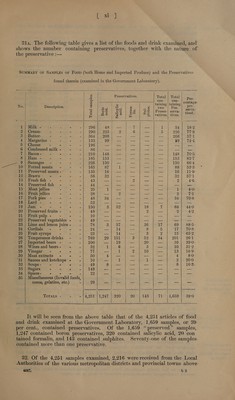
![ae ae _ 12. Our Inquiry naturally cimided itself into two parts [1] Preservatives, and [2] Colouring Matters. I.—PRESERVATIVES. 13. That articles of food can be preserved—that is, so treated that their decomposition can be prevented, or at least retarded—by the use of a number of substances, such as oils, spirits of wine, vinegar, salt, sugar, etc., has been known from very early times, but until comparatively recently the preservative agents used were, for the most part, of natural origin and Vasey, of the nature of foods themselves. It was surmised that the changes to Appendix X. which food is liable were, broadly speaking, akin in character to fermenta- tion, and hence when the real nature of fermentation came to be known, and when it was ascertained how the action of ‘‘ferments” could be controlled or even inhibited by cold, heat, sterilisation, or by the action of chemical substances, the art of preserving food was placed upon an intelligible basis. 14. Concurrently with the development of our knowledge of the part played by ‘“ferments ”—organised and unorganised—-in effecting putrefactive or fermentative changes, the extraordinarily rapid progress of chemistry, and especially of organic chemistry, during the last half century, has made known the existence of many new substances capable of either wholly preventing or greatly retarding such changes. ‘These artificial substances are classed generically as “antiseptics,” and it was but natural that attempts should be made to use them in the conservation of food. Their application was, however, restricted by the circumstances that many of them were actively poisonous, or rendered food unpalatable, or that they were too costly for use on a commercial scale. 15. From the evidence brought before the Committee it would appear that at the present time the only artificial or chemical antiseptic agents other than those alluded to above (Paragraph 13) employed, or said to be employed, in the preservation of food are— Boric or boracic acid and borates ; so called ‘“‘ boron preservatives,” Sulphurous acid and sulphites, Fluorides, Salicylic acid, Benzoic acid or benzoates, Formalin or formaldehyde. 16. As regards fluorides, benzoic acid, and the benzoates it may be said Fluorides, | | at once that, if employed at all, their use must be extremely limited. ponzols aad and Except Messrs. Boseley, Cassal, Droop Richmond, and Vasey, none Boseley, 1046 of the witnesses who appeared before the Committee were able’ Vasey, 2043, to speak of their use from personal knowledge, nor were these sub- 2046. stances detected in any of the samples of food or drink examined in rea qe the Government Laboratory. Mr. Leonard Boseley, analyst to Messrs. °°’ eS Keiller and Son, Limited, stated in evidence that he believed that a firm | in London were trying to get benzoate of soda taken up as a preservative for jams; but it is not being used, at any rate at present, in any great . quantity. ? 17. The boron preservatives are preparations of borax and boracic acid Hote Preserva (with or without admixture of other preservative ingredients, such as salt, salt- ne petre, sugar, carbonate of soda, etc.), and are generally sold in the form of a white powder (sometimes, however, coloured with a coal-tar dye) under a great _yariety of fanciful names, which as a rule afford no clue to their real nature. The composition of a number of these boron preservatives, as ascertained in the Government Laboratory, is given in Appendix VIII. (Table H.). They are used largely for dairy produce (especially in milk, butter, and cream), for margarine, ham, bacon, sausages, and preserved meat foods generally, and to a much smaller extent in beverages.](https://iiif.wellcomecollection.org/image/b3217228x_0013.jp2/full/800%2C/0/default.jpg)