Report on sleeping sickness in northern Rhodesia to February 1912 / by A. May.
- May, A.
- Date:
- 1912
Licence: In copyright
Credit: Report on sleeping sickness in northern Rhodesia to February 1912 / by A. May. Source: Wellcome Collection.
Provider: This material has been provided by London School of Hygiene & Tropical Medicine Library & Archives Service. The original may be consulted at London School of Hygiene & Tropical Medicine Library & Archives Service.
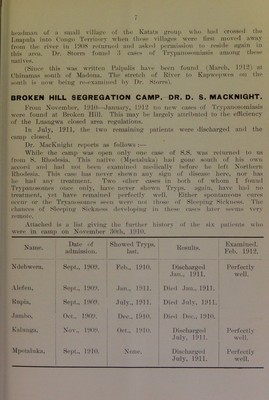
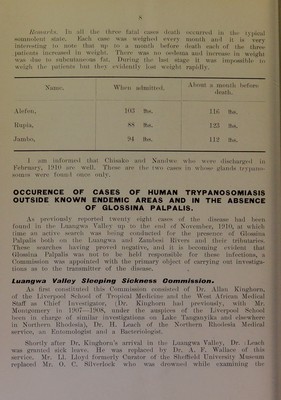
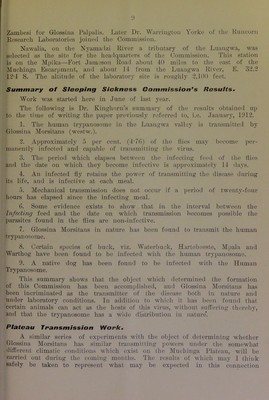
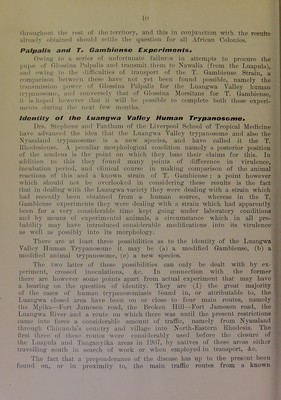
16/38 (page 10)
![lu throughout the i-est of the territory, and this in conjunction with the resnhs alrea(ly obtained should settle the question for all African Colonies. Palpalis and Tm Gambiense ExperimontSm Owing to a series of unfortunate failures in attempts to procure the pupa' of Olossinu Palpalis and transmit them to Nawalia (from the Luapula), and owing to the dilliculties of transport of the T. Gambiense Strain, a comi^arison between these have not yet been found possible, namely the transmission ])ower of Glossina Palpalis for the Luangwa Valley human trypanosome, and conversely that of Glossina Morsitans for T. Gambiense, it is lioped however that it will l)c possible to complete both these experi- ments during the next few months. Identity of the Luangwa Valley Human Trypanosomem Drs. Stephens and Fantham of the Liverpool School of Tropical Medicine have advanced the idea that the Luangwa Valley trypanosome and also the Nyasaland trypanosome is a new species, and have called it the T. Rhodesiense. A peculiar moi-phological condition namely a posterior position of the nucleus is the point on which they base their claims for this. In addition to this they found many points of difference in virulence, incubatioii period, and clinical course in making comparison of the animal reactions of this and a known strain of T. Gambiense ; a point however which should not be overlooked in considering these results is the fact that in dealing with the Luangwa variety they were dealing with a strain which had recently been olitained from a human source, whereas in the T. Gambiense experiments they were dealing with a strain which had apparently been for a very considerable time kept going under laboratory conditions and by means of experimental animals, a circumstance which in all pro- bability may have introduced considerable modifications into its virulence as well as possibly into its morphology. There are at least three possibilities as to the identity of the Luangwa Valley Human Trypanosome it may be (a) a modified Gambiense, (b) a modified animal trypanosome, (c) a new species. The two latter of these possibilities can only be dealt with by ex- periment, crossed inoculations, &c. In connection with the former there are however some points apart from actual experiment that may have a beai’ing on the question of identity. They are (1) the great majority of the cases of human trypanosomiasis found in, or attributable to, the Luangwa closed area have been on or close to four main routes, namely the Mpika—Fort Jameson road, the Broken Hill—Fort Jameson road, the Luangwa River and a route on which there was until the present restrictions came into force a considerable amount of traffic, namely from Nyasaland through Chiminda’s country and village into North-Eastern Rhodesia. The first three of these routes wei’e considerably used before the closure of the Luapula and Tanganyika areas in 1907, bj' natives of these areas either travelling soiith in search of work or when employed in transport, &c. The fact that a preponderance of the disease has up to the present been found on, or in proximity to, the main trafl&c routes from a known](https://iiif.wellcomecollection.org/image/b24916134_0018.jp2/full/800%2C/0/default.jpg)