Science papers : chiefly pharmacological and botanical / by Daniel Hanbury ; edited, with memoir, by Joseph Ince.
- Daniel Hanbury
- Date:
- 1876
Licence: Public Domain Mark
Credit: Science papers : chiefly pharmacological and botanical / by Daniel Hanbury ; edited, with memoir, by Joseph Ince. Source: Wellcome Collection.
91/578 page 71
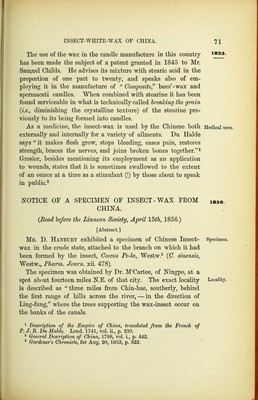
![The use of the wax in the candle manufacture in this country ^S53. has been made the subject of a patent granted in 1845 to Mr. Samuel Childs. He advises its mixture with stearic acid in the proportion of one part to twenty, and speaks also of em- ploying it in the manufacture of Composite, bees'-wax and spermaceti candles. When combined with stearine it has been found serviceable in what is technically called breaking the grain (i.e., diminishing the crystalline texture) of the stearine pre- viously to its being formed into candles. As a medicine, the insect-wax is used by the Chinese both Medical uses, externally and internally for a variety of ailments. Du Halde says it makes flesh grow, stops bleeding, eases pain, restores strength, braces the nerves, and joins broken bones together.^ Grosier, besides mentioning its employment as an application to wounds, states that it is sometimes swallowed to the extent of an ounce at a time as a stimulant (!) by those about to speak in public.^ NOTICE OF A SPECIMEN OF INSECT-WAX FEOM lese. CHINA. (Bead before the Linnean Society, April 15th, 1856.) [Abstract.] Mr. D. Hanbury exhibited a specimen of Chinese Insect- Specimen, wax in the crude state, attached to the branch on which it had been formed by the insect, Coccus Pe-la, Westw.^ ((7. sinensis, Westw., Pharm. Journ. xii. 478). The specimen was obtained by Dr. M'Cartee, of Ningpo, at a spot about fourteen miles N.E. of that city. The exact locality Locality, is described as three miles from Chin-hae, southerly, behind the first range of hills across the river, — in the direction of Ling-fung, where the trees supporting the wax-insect occur on the banks of the canals. ^ Description of the Empire of China, translated from the French &f P. J. B. Du Halde. Lond. 1741, vol. ii., p. 230. ^ General Description of China, 1788, vol. i., p. 442. ^ Gardener's Chronicle, for Aug. 20, 1853, p. 532.](https://iiif.wellcomecollection.org/image/b20419831_0091.jp2/full/800%2C/0/default.jpg)


 No text description is available for this image
 No text description is available for this image
 No text description is available for this image