Report of the trial on an indictment for libel in "The American lancet" : containing the whole evidence, speeches of counsel, recorder's charge, &c. : accusers in behalf of the state, J.B. Beck, E.G. Ludlow, and divers others against J.G. Vought, Wm. Anderson & Samuel Osborn.
- John G. Vought
- Date:
- [1831]
Licence: Public Domain Mark
Credit: Report of the trial on an indictment for libel in "The American lancet" : containing the whole evidence, speeches of counsel, recorder's charge, &c. : accusers in behalf of the state, J.B. Beck, E.G. Ludlow, and divers others against J.G. Vought, Wm. Anderson & Samuel Osborn. Source: Wellcome Collection.
Provider: This material has been provided by the National Library of Medicine (U.S.), through the Medical Heritage Library. The original may be consulted at the National Library of Medicine (U.S.)
43/58
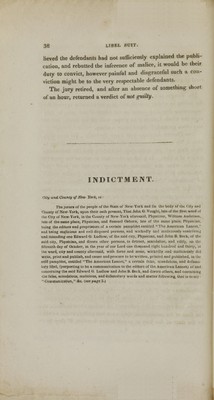
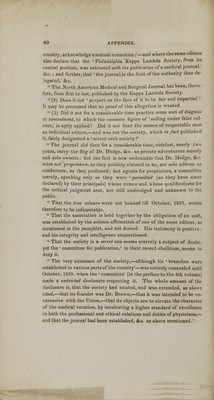
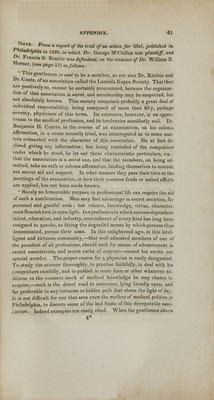
![* did not read in my opening, unless he will allow me to argue on the portion that he wishes to read. The District Attorney said he had allowed Dr. Vought to read at great length what he pleased, and thought it unfair that Dr. V. should deprive him of reading one or two lines. Dr. Vought said, if your Honour will allow me to argue on the points he wishes to read, and give me a chance to rebut the impression they may make on the minds of the jury, he may read the whole Lancet if he please, with all my heart; but on any other ground, I object to his reading. The District Attorney laid down the book. He soon after closed his speech by saying, that the jury must, according to their duty and the oaths they had taken, find the defendants guilty of a libel. It is left to the court to impose the penalty. [For what the District Attorney wanted to read, see Appendix [C] in this work, consisting of six queries, which no gentleman, either in the Barclay-street College, or in the Medical Society, have as yet thought proper to answer. We are willing these queries should be read and answered to the full satisfaction of the seventeen alluded to in the Lancet.] The Recorder, in his charge to the jury, gave a lucid and interesting exposition of the law of libel. He considered the subject from the earliest period, and traced the times and causes which moderated its rigour. He gave his opinion of the prin- ciples upon which the jury should determine the matter sub- mitted to their adjudication : he held, that if they were of opi- nion, that the libellous matter was false as regarded Drs. Beck and Ludlow, (of which he professed himself to have no doubt) that it was then their duty to raise an inference that it was ma- licious; that the inference of malice must be rebutted by the defendants; that if the jury believed the defendants had no bad intention in their hearts towards Beck and Ludlow, or in other words, had rebutted the inference of malice towards them, at the time of the publication, they were not guilty, and it would be the duty of the jury to acquit them; but that, if they be- 4](https://iiif.wellcomecollection.org/image/b21161665_0043.jp2/full/800%2C/0/default.jpg)