Volume 1
Encyclopædia of chemistry, theoretical, practical, and analytical, as applied to the arts and manufacturers / by writers of eminence. Illustrated with numerous wood-cuts and steel-plate engravings.
- Date:
- 1877-1879
Licence: Public Domain Mark
Credit: Encyclopædia of chemistry, theoretical, practical, and analytical, as applied to the arts and manufacturers / by writers of eminence. Illustrated with numerous wood-cuts and steel-plate engravings. Source: Wellcome Collection.
42/1132 page 26
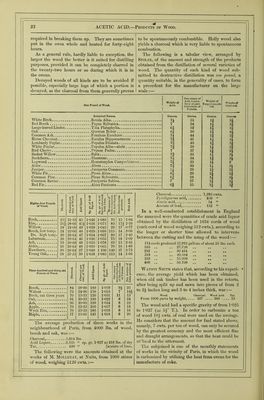
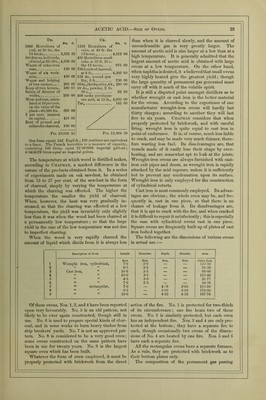
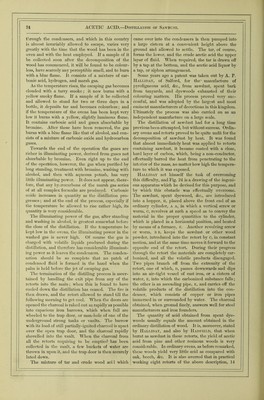
![Solomons and Azulay have i^atented a process, the main feature in which is the transmission of steam heated to a high temperature through tlie mass of material. The steam pipes are so arranged that every particle of sawdust is exposed to the superheated steam, and is thus completely carbon- ized. The products are those ordinarily obtained in ligneous distillation. The steam accoinpanying the distillates renders them dilute; this drawback is, however, compensated to a great extent by causing tlie mixed steam and volatile products to traverse a coil of piping placed in a pan of the distillates, from which the pyroligneous acid and other products ]3ass to the main condenser. If this had not been suggested by a chemist, the patent could never have been profitably worked. The heated steam prevents the deposit of tarry and other resinous matters; consequently, no choking of tlie pipe need be appre- hended. The following brief sketch of the pyroligneous acid manufacture was contributed by John Randall, manager of the Pitchcoombe Works at Stroud, to the last edition of this dictionary:— “ It remains still a disputed point whether small or large retorts are preferable. After a trial of different sizes, and some years’ experience, the writer considers a retort of moderate dimensions the most convenient and serviceable. Those in use here are 9^ feet in length and 2^ feet in diameter, inclosed in brickwork, and placed horizontally, three or five in a set. “They are secured in front by lids, fastened by means of a cross bar. At the back there is an exit pipe, 8 inches in diameter, connected with a main pipe. From this the liquor is conducted by a series of pipes, immersed in water, into a large tank. Retorts set in the method described are heated more economically, and the charcoal is good. “ Each retort holds about half a cord of wood, which, when of beech of the average dryness, weighs about 12 cwts. These retorts are charged once in twenty- four hours. As to the quantity of liquor produced from a given weight of wood, of course much depends 4OU the condition of the wood, whether green or dry —that which has been cut down about six months is the best for practical purposes, the liquor being stronger in acid. A cord of wood in this state yields from 120 to 130 gallons of liquor, consisting of pyro- ligneous acid, water, naphtha, and tar, leaving char- coal in the retort equal in amount to about one-fifth of the weight of the wood originally employed. The next process is to separate these various products, and for this purpose the liquor is pumped up into copper stills, heated for safety by steam. Naphtha, in a weak and impure state, comes over first, then the pyroligneous acid, leaving a tarry residuum in the retort. Some manufacturers prefer adding lime to the liquor in the tank before it is transferred to the stills: this is, perhaps, best for the production of naphtha, but it involves tlie necessity of making black or brown acetate of lime, which from its in- ferior quabty is often difficult of sale, except at a low j)rice. “ After distillation the acid is removed to large tubs or vats, and neutralized with lime. It is then allowed to stand for a ftw hours, and the clear solution siphoned off into evaporating pans. The vessels used here for this purpose are made of wrought ii-on, are oblong in shape, about 9 feet in length, 4 feet in width, and 2 feet in depth ; they contain about 460 gallons. The solution is boiled down to the desired consistency, put into draining buckets, and then removed to a drying stove. This is the ordinary process; but when the acetate is required of superior quality, the solution is properly evaporated, then allowed to stand for eight or ten hours, carefully drained off from its sediment, and boded to its crystallizing point. Simple distillation, though it separates a large portion of tarry matter, never renders the pyroligneous acid pure; this can only be effected by neutralizing the acid with carbonate of soda, evaporating the solution to dryness, and then subjecting the mass to fusion. The resulting black cake, as it is termed, is redissolved, boiled to a crystallizing point, and drawn out into large shallow vessels to deposit the salt.” Some time back Pauer discovered a method for the preparation of acetic acid and acetates from the distillation of wood, in which he dispensed with dis- tillation, evaporation, and the greater part of the heating required in the processes generally pursued in this branch of the manufacture. His metliod consisted in presenting to the acetic acid vapour, during the carbonization of the wood, a substance which can seize exclusively upon it, and thereby concentrate it. The bodies which will the most readily satisfy this condition are those bases whose acetates are not decomposable at the temperature of the opera- tion ; such as potassa, soda, baryta, lime, magnesia, &c., or the carbonates of these bases, or any other salt whose acid can be displaced by the acetic acid. The author gives the preference, according to locality, to lime, a calcareous carbonate, mag- nesian carbonate, or carbonate of soda. The first three on account of their low price ; the last because it yields the acetate of soda directly—a product prepared at a future stage for the entire purification of the acid. Pauer’s process may be applied to any method of carbonization. The manner in which it is adapted to carbonization en meides—piles or masses of rough wood with earth—will now be described. It is well known that carbonization en menles is effected by the heat produced by means of the com- bustion of a certain quantity of the wood of the pile when ignited. Orifices left at the foot of the pile give access to the air necessary for combustion; others pierced at different heights and in different positions by the workman charged with directing the progress of the carbonization, serve for the escape of the products of the combustion and distil- lation. In these last orifices, at the point where the workman has judged it necessary to carry the draught, M. Pauer introduces tubes into the earth of about one inch interior diameter and half an inch](https://iiif.wellcomecollection.org/image/b28127055_0001_0042.jp2/full/800%2C/0/default.jpg)