An introduction to the science of botany : chiefly extracted from the works of Linnaeus, to which are added several new tables and notes and a life of the author / by the late James Lee.
- James Lee
- Date:
- 1810
Licence: Public Domain Mark
Credit: An introduction to the science of botany : chiefly extracted from the works of Linnaeus, to which are added several new tables and notes and a life of the author / by the late James Lee. Source: Wellcome Collection.
Provider: This material has been provided by King’s College London. The original may be consulted at King’s College London.
84/636 (page 56)
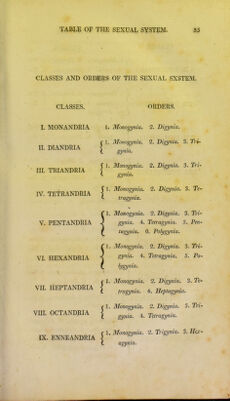
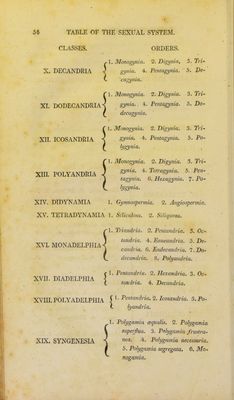
![CLASSES. ORDERS. fl. Monogynia. 2. Digynia. 3. Tri- X. DECANDRIA -J gynia. 4. Pentagynia. 5. De- (~ cagynia. C1. Monogynia. 2. Digynia. 3. Tri- XI. DODECANDRIA< g]/nia- 4- Pentagynia. 5. Do- £ decagynia. f I. Monogynia. 2. Digynia. 3. Tri- XII. ICOSANDRIA < 4- Pentagynia. 5. Po- f\. Monogynia. 2. Digynia. 3. TW- XIII. POLYANDRIA ) *' f^®*. 5- J tagynia. o. Hexagyma. 7- Po- XIV. DIDYNAMIA 1. Gymnospennia. 2. Angiospermia. XV. TETRADYNAMIA 1. SiliciXosa. 2. Siliqitosa. XVI. MONADELPHIA < 1. Triandria. 2. Pentandria. 3. 0c- tundria. 4. Enneandria. 5. De- candria. 6. Endecandria. I.Do- decandria. 8. Polyandria. f 1. Pentandria. 2. Hexandria. 3. Oc- XVII. DIADELPHIA { , . J - t tandria. 4. Decandria. XVIII. POLYADELPHIA J ** Pentandria> 2- Icosandria. 3.Po- t lyandria. .1. Polygamia equalis. 2. Polygamia superflua. 3. Polygamia frustra- nea. 4. Polygamia necessaria. 5. Polygamia segregate. 6. ilfo«](https://iiif.wellcomecollection.org/image/b21299468_0084.jp2/full/800%2C/0/default.jpg)