Content advisory
This digitised material is free to access, but contains information or visuals that may:
- include personal details of living individuals
- be upsetting or distressing
- be explicit or graphic
- include objects and images of objects decontextualised in a way that is offensive to the originating culture.
Licence: In copyright
Credit: Monod, Jacob, Lwolf: Nobel Prize Lectures. Source: Wellcome Collection.
46/69
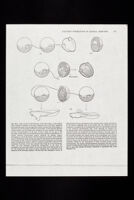
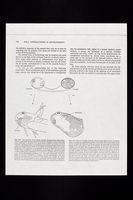
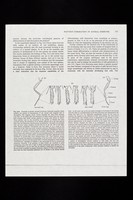
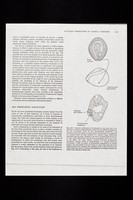
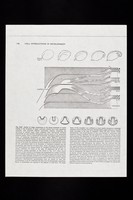
![recombinant cells in this example are expressing one of the 'homeotic' class of mutations [14], which, when available for expression in all cells, characteristically cause one imaginai disk to develop in the form of other regions of the body normally derived from entirely different disks. In the cases shown here recombinant cells are differentiating in quite different ways from normal and from their surrounding cells due to the purely intrinsic influence of a single modified gene. A wide variety of evidence shows that, far from its being the case that influences external to the developing embryonic cell can alone cause it to conform to the overall pattern of differentiation, the cell itselfplays a decisive part. Following sections will present two contrasting models, each of which seems, at the present time, to offer a causal description of embryogenesis and each of which attempts to identify these two factors of cell constitution and external coordinating influences. It must be emphasized that no attempt will be made to give a systematic account of embryonic development or of all possible relevant explanatory models and that much of the discussion which follows is necessarily or deliberately speculative. 3.6.2 THE POSITIONAL INFORMATION MODEL In considering the wide varieties of differentiating insect tissues which can, by the formation of genetic mosaics, be brought into conjunctions which would never occur during normal development, Stern [15] has emphasized the normality of the patterns of differentiation of the separate parts of the mosaics. Even though, up to the time of genetic recombination, imaginai disk cells are clearly open to modification of their future courses of development, there are few distortions or deficiencies in finally formed adult structures such as might indicate interactions with or dependencies upon the nature of differentia tion of nearby tissue. As an example of such 'autonomy' in the development of elements in a pattern, Fig. 3.6.6 shows fully differentiated mosaic limbs, formed out of second limb imaginai disk tissue containing patches of cells which, as a result of their expression of a particular homeotic mutation, differentiate atypically in forms characteristic of the first limb. Regardless of where a recombinant cell happens to occur, it invariably differentiates in the form in which normal first limb cells at cor responding positions in the first limb would differentiate, even when it is completely surrounded by normal second limb tissue. On the one hand this result points to the fact that in selecting a pattern of differentiation a developing cell can choose in dependently of the way in which cells in its immediate surroundings are developing. On the other hand, in order to develop in the one limb as though they were at precisely comparable positions in the other, it would seem that recombinant cells must be receiving information based on the large scale, general anatomical features that the two limbs have in common and therefore based on distant surrounding tissue as a whole. Pursued to its logical conclusion evidence of this sort means that, for a cell to be able to develop entirely in dependently of the states of differentiation occurring elsewhere in the tissue, the information it receives must be provided by a means which is itself quite independent of differentiation occurring within the tissue. One way in which this could be done, so that cells would directly and unfailingly be able to develop in accordance with their positions, is that mechanisms are provided within the embryo for the specific purpose of defining positions as such. This is the positional information model [17]. As evidence that position as such is defined in an embryo the experiments shown in Fig. 3.6.5 are important. These show that the potentiality to form the balancer organ characteristic of a particular amphibian species, is inherent throughout the embryonic ectoderm of that species. It can be released in any part of the prospective belly ectoderm which happens to occupy the appropriate highly specific position on the head following transplantation. This can only be explained if the tissues of the host embryo had precisely defined this position and in a unique way so that balancers never form elsewhere. The experiment also shows that the appropriate site is defined even in the embryo of a species in which—since it itself is never normally able to form any organ at that site and cannot normally form a balancer of any kind—there is no reason to suspect that this site should be particularly singled out for definition, let alone in a way specific for balancer promotion. These observations can be readily explained if we suppose that any site in the embryo is defined as a matter of course during embryogenesis and in a general way without regard to how this information might be used, so that whatever the potentiality of a cell it can develop in the appropriate way at each and every position. Having been provided with information about its position in the embryonic tissue as a whole, each cell would then be able to achieve the pattern of differentiation appropriate to its position in the future adult by referring to an inbuilt set of instructions relating differentiation to positional values. At this point the model brings in the parameter of cell constitution and in particular the repository of potentialities which the genome provides. Even when cells carry a mutation which causes a new pattern of differentiation to occur at a particular location, a suitably placed cell could, given positional information, express the pattern of differentiation appropriate to its constitution directly and independently of the constitutions of surrounding cells. So autonomy of differentiation in genetic mosaics is explained. The coordinated development of tissues with different genotypes, including even tissues of different species, is also a accounted for provided that the positional information channels of each are of sufficiently general a form to be interchangeable.](https://iiif.wellcomecollection.org/image/b18189337_PP_CRI_H_3_5_4_0046.jp2/full/800%2C/0/default.jpg)
 No text description is available for this image
 No text description is available for this image
 No text description is available for this image