Content advisory
This digitised material is free to access, but contains information or visuals that may:
- include personal details of living individuals
- be upsetting or distressing
- be explicit or graphic
- include objects and images of objects decontextualised in a way that is offensive to the originating culture.
Licence: In copyright
Credit: Monod, Jacob, Lwolf: Nobel Prize Lectures. Source: Wellcome Collection.
59/69
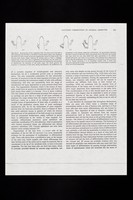
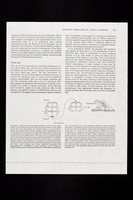
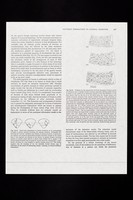
![by the genetic mosaic technique involve tissues with various degrees of structural homology. All the structures concerned are cuticular derivatives of segmentally arranged imaginai disks, which have many features in common in their development. For example, they all undergo similar patterns of eversión at metamorphosis, they are affected by the same mutations specifically blocking disk development [14, 64] and many show the duplicative pattern of regeneration [13, 14] which is indicative of a polarized sequence of development like that of the vertebrate limb (Fig. 3.6.13). The two organs involved in the extra sex-comb mutation (Fig. 3.6.6), the first and second legs, are obviously similar in the arrangement of most of their component parts. Indeed, it is only because of this homology that it is possible to judge the extent to which tissue of one kind develops appropriately according to its position in the context of tissue of the other kind. In circumstances such as these, in which homologous structures in the two parts of the genetic mosaic may provide interchangeable inductive cues, distortions of pattern revealing inductive interdependence would be expected to be. at the most, small. The embryogenesis of insects is sufficiently similar to that of vertebrates [59] that there is no reason to doubt that it could similarly be based on inductive interactions [60]. Detailed examination of genetic mosaics in which autonomy seemed to apply reveals that the site of formation of cuticular organelles such as bristles are influenced on a small scale by surrounding tissue context (Figs 3.6.6, 3.6.15). It is established, from studies of mosaics of disk tissue formed either genetically or by mechanical mixing of cells, that the formation of bracts is solely dependent on the influence of other previously formed organelles [13. 14]. The formation and arrangement of bristles can in general be adequately accounted for in terms of inductive and morphogenetic interactions which are known to operate during the development of insect cuticle (Figs 3.6.6, 3.6.16). Thus the available evidence does not uniquely require an explanation in terms of the positional information model to the Fig. 3.6.15 Small-scale dependence of bristle formation on its surroundings revealed in genetic mosaics involving the achaete mutation. Drosophila flies carrying the 'achaete' mutation lack bristles at certain locations: in particular, the anterior and posterior dorsocentral bristles (normally located on the dotted lines in the diagram) are missing on the thorax. In genetic mosaics involving patches of mutant tissue (shown in black) these bristles fail to appear if the normal bristle locations are occupied by mutant tissue but occasionally a single bristle will form at a new location in nearby normal tissue [151. This finding suggests that the locations of the two normally formed bristles may be dependent on the nature of surrounding tissues—perhaps, on mutual inhibitory interactions. 0'5mm Fig. 3.6.16 Evidence for the dependence of bristle formation in insect cuticle on influences due to already formed cuticular organelles. Bristles added (shown in black) to the cuticle of an abdominal segment of the bug Rhodnius, as the larva grows from its 4th (a) to its 5th larval instar (b), occupy spaces over certain minimum distances from already formed bristles. Thus stretching or growth of spaces between bristles may directly control future bristle formation by moving potential bristle cells out of range of an inhibitory influence due to cells which have already so differentiated. In (c) the pattern was modified ex perimentally by mechanically stretching the cuticle; further bristles were added in the same way 1611. Where various kinds of organelle are formed by the cuticle these may or may not influence one another's development according to similar inhibitory interactions 1621. Bristles formed at different times may vary in size (larger bristles—like sex-comb bristles—may be those which are formed earliest) and where one large bristle is missing several small ones may be able to appear later (621. Given these variables much of the observed variety of cuticular patterns of differentiation may be referable to patterns of variable rates of cuticular growth, as in the case of the sex-comb (Fig. 3.6.6). Patterns of development in particular locations, such as are selectively affected in mutations like achaete and scute [151, may involve cuticular regions made distinctive by their particular rates of growth and their particular bristle-forming potencies. exclusion of the induction model. The induction model incorporates most of the observations whereas many, such as cases of nonautonomy just referred to, are difficult to account for on the alternative model. The fact that organs can be caused to form far from their normal positions or contexts by homeotic mutations is at first sight incompatible with either model. On the grounds of a similar homology of the tissues concerned, none of the evidence for the autonomy of differentia tion of elements in a pattern (on which the positional](https://iiif.wellcomecollection.org/image/b18189337_PP_CRI_H_3_5_4_0059.jp2/full/800%2C/0/default.jpg)
 No text description is available for this image
 No text description is available for this image
 No text description is available for this image