Content advisory
This digitised material is free to access, but contains information or visuals that may:
- include personal details of living individuals
- be upsetting or distressing
- be explicit or graphic
- include objects and images of objects decontextualised in a way that is offensive to the originating culture.
Licence: In copyright
Credit: Monod, Jacob, Lwolf: Nobel Prize Lectures. Source: Wellcome Collection.
60/69
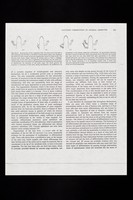
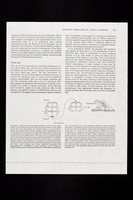
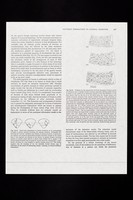
![information model is founded), can be taken to exclude the possible explanation of the findings in terms of embryonic induction. Thus combinations of forelimb and hindlimb tissue in vertebrates (Fig. 3.6.12C) may become integrated in their patterns of differentiation because the two limbs are broadly homologous in their anatomy and in their patterns of development (Fig. 3.6.12B). The normal development of an organ such as a balancer, in tissue of one species transplanted to a species normally without any organ at the relevant location (Fig. 3.6.5), is hardly surprising if, as seems likely (Fig. 3.6.9), organs homologous to its normal inductor are present in the host species. The same point applies to melanocytes of one avian breed which form their own uniquely characteristic patterns of pigmentation by making use of the tissues of another breed (Fig. 3.6.11). It is clear (Figs 3.6.3, 3.6.4, 3.6.5, 3.6.7, 3.6.9, 3.6.11) that a difference in the species of origin of embryonic tissues is no barrier to their normal involvement in inductive interactions at all stages of development. 3.6.5 ON THE GENETIC CONTROL OF DEVELOPMENT—HOMEOTIC MUTATIONS By specifically causing cells with prospective developmental fates as part of one organ to differentiate in the form of a completely different organ, homeotic mutations would appear to duplicate exactly the effect of embryonic inductions (as seen in Fig. 3.6.7). Thus they offer the prospect of providing a direct link between the embryonic cell interactions which control differentiation, and the store of information in the form of genes (provided initially by the egg) which must tell the cells how to do it. Nor are homeotic mutations unique to insects or to imaginai disks. A dominant mutation has been described in the chicken in which the forelimb develops substantially in the form of the hindlimb [28] (Fig. 3.6.12C). As a result of separate homeotic mutations the imaginai disks which would normally form such highly specialized head and tail parts as the eye, the proboscis, the antenna or the genitalia can be caused to form one of the body parts such as wings, legs, halteres or body segments 114] which, since they have a greater number of structural features obviously in common, may be considered less highly divergent forms of what were perhaps initially similar patterns of development in all disks. The disks of these latter organs also commonly transform among themselves (different mutations can bring about transformations in either direction between any of them) but it is notable that they rarely if ever transform into head or tail structures. Two points can be made about the nature of homeotic transformations in general. Firstly, it is clear that, if the expected pattern of differentiation fails in a disk due to the action of the mutation, each disk has the potentiality to express one of a number of other forms of cuticular development. This shared pattern of multipotency is perhaps not surprising, in view of what has already been said about the multipotency of epithelia in vertebrates, since imaginai disks are primarily composed of cells directly derived, apparently unchanged, from the ectodermal stem cell line as it existed early in development. The fact that future patterns of differentiation can be changed in many way by homeotic mutations, even when they are made operative by chromosomal recombination of mid-larval stages, confirms that all imaginai disks may retain the identical and complete multipotency of ectoderm until they start to differentiate at metamorphosis. Secondly, it is known that imaginai disks cultured in vivo spontaneously transform ('transdetermination', Chapter 2.1) into the patterns of differentiation typical of other disks [14] in the same way as is seen to occur due to homeotic mutations but in this case in the absence of heritable genetic changes. Similar transformations of organ-type occur during regeneration of appendages in adult insects [14]. Thus, in line with the principle that mutations are usually deleterious, the direct and single effect of the mutation might be confined tó causing failure in the particular patterns of differentiation needed in a given imaginai disk to allow it to fulfil its characteristic form of development: the substitution of another organ may be quite incidental to the genetic change. It is a possibility that some homeotic mutations are lethal to the cells expressing their effects and that the homeotic substitutions are simply the result of anomalous regeneration from surrounding unaffected ectoderm. However, the fact that homeotic mutations in general appear to result in transformations from more specialized structures to less, and not the reverse, suggests that the particular substitute for a highly specialized disk may represent a degree of tissue organization which that disk would normally pass through in attaining its specialized development, now revealed because development beyond this point is impossible due to the elimination by the mutation of the required additional specialized developmental pathway. The only homeotic mutation in which the mode of action of the affected gene can be pinpointed is the extra sex-comb mutation in Drosophila (Fig. 3.6.6) involving the substitution of the second leg by a first leg. These two organs are obviously homologous in structure. In fact many anatomical regions in the one are identical to those in the other and the major differences between them, such as the presence of a sex-comb only in the first, affect only particular regions. The use of genetic mosaics involving this mutation (Fig. 3.6.6) makes it possible to show that the sex-comb may be no more than a single, regionally circumscribed extension to a pattern of development which is intitially common to both limbs. The difference may consist simply of an enlargement of bristles in a certain region and associated morphogenetic rearrangements. This example illustrates how a single mutation can result in a homeotic substitution where the distinctions between two organs depend](https://iiif.wellcomecollection.org/image/b18189337_PP_CRI_H_3_5_4_0060.jp2/full/800%2C/0/default.jpg)
 No text description is available for this image
 No text description is available for this image
 No text description is available for this image