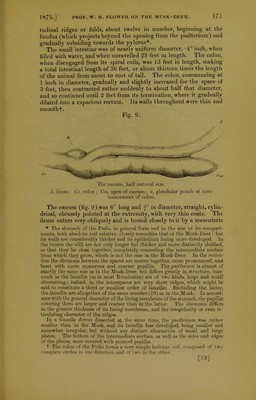
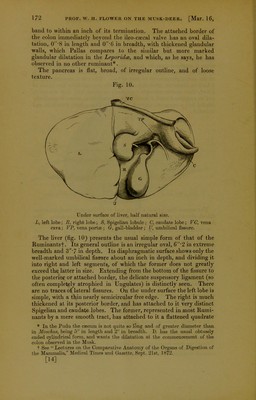
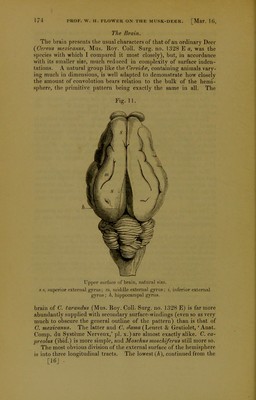
On the structure and affinities of the musk-deer (Moschus mosciferus, Linn.) / by William Henry Flower.
- William Henry Flower
- Date:
- 1875
Licence: Public Domain Mark
Credit: On the structure and affinities of the musk-deer (Moschus mosciferus, Linn.) / by William Henry Flower. Source: Wellcome Collection.
Provider: This material has been provided by The Royal College of Surgeons of England. The original may be consulted at The Royal College of Surgeons of England.
17/32 page 175
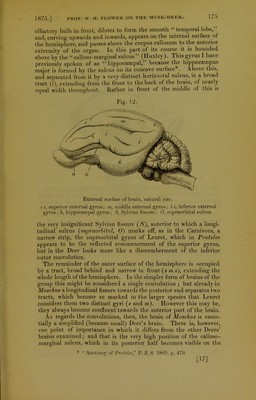
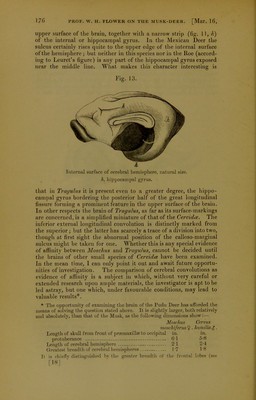
![olfactory bulb in front, dilates to form the smooth “ temporal lobe, and, curving upwards and inwards, appears on the internal surface of the hemisphere, and passes above the corpus callosum to the anterior extremity of the organ. In this part of its course it is bounded above by the “ calloso-marginal snlcus ” (Huxley). I his gyrus I have previously spoken of as “ hippocampal,” because the hippocampus major is formed by the sulcus on its concave surface*. Above this, and separated from it bv a very distinct horizontal sulcus, is a broad tract (i), extending from the front to the back of the brain, of ncaily equal width throughout. Rather in front of the middle of this is Fig. 12. External surface of brain, natural size. $ s, superior external gyrus; m, middle external gyrus; i i, inferior external gyrus ; h, hippocampal gyrus; 8, Sylvian Assure ; 0, supraorbital sulcus. the very insignificant Sylvian fissure (/S'), anterior to which a longi- tudinal sulcus (supraorbital, O) marks off, as in the Carnivora, a narrow strip, the supraorbital gyrus of Leuret, which in Proteles appears to be the reflected commencement of the superior gyrus, but in the Deer looks more like a dismemberment of the inferior outer convolution. The remainder of the outer surface of the hemisphere is occupied by a tract, broad behind and narrow in front (s in s), extending the whole length of the hemisphere. In the simpler form of brains of the group this might be considered a single convolution ; but already in Moschus a longitudinal fissure towards the posterior end separates two tracts, which become so marked in the iarger species that Leuret considers them two distinct gyri (s and m). However this may be, they always become confluent towards the anterior part of the brain. As regards the convolutions, then, the brain of Moschus is essen- tially a simplified (because small) Deer’s brain. There is, however, one point of importance in which it differs from the other Deers’ brains examined; and that is the very high position of the calloso- marginal sulcus, which in its posterior half becomes visible on the * “Anatomy of Proteles, P. Z. S. 18IS9. p. 47b. [17]](https://iiif.wellcomecollection.org/image/b22455310_0019.jp2/full/800%2C/0/default.jpg)