On the structure and affinities of the musk-deer (Moschus mosciferus, Linn.) / by William Henry Flower.
- William Henry Flower
- Date:
- 1875
Licence: Public Domain Mark
Credit: On the structure and affinities of the musk-deer (Moschus mosciferus, Linn.) / by William Henry Flower. Source: Wellcome Collection.
Provider: This material has been provided by The Royal College of Surgeons of England. The original may be consulted at The Royal College of Surgeons of England.
19/32 page 177
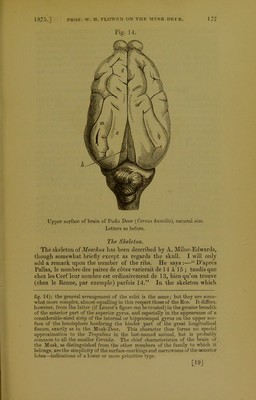
![Fig. 14. Upper surface of brain of Pudu Deer (Cervus humiUs), natural size. Letters as before. The Skeleton. The skeleton of Moschus has been described by A. Milne-Edwards, though somewhat briefly except as regards the skull. I will only add a remark upon the number of the ribs. He says :—“ D’apres Pallas, le nombre des paires de cotes varierait de 14 a 15 ; tandis que chez lesCerf leur nombre est ordinairement de 13, bien qu’on trouve (chez le Renne, par exemple) parfois 14.” In the skeleton which fig. 14); the general arrangement of the sulci is the same; but they are some- what more complex, almost equalling in this respect those of the Roo. It differs, however, from the latter (if Leuret’s figure can be trusted) in the greater breadth of the anterior part of the superior gyrus, and especially in the appearance of a considerable-sized strip of the internal or hippocampal gyrus on the upper sur- face of the hemisphere bordering the hinder part of the great longitudinal fissure, exactly as in the Musk-Deer. This character thus forms no special approximation to the Tragulina in the last-named animal, but is probably common to all the smaller Cervida. The chief characteristics of the brain of the Musk, as distinguished from the other members of the family to which it belongs, are the simplicity of the surface-markings and narrowness of the anterior lobes—indications of a lower or more primitive type. [19]](https://iiif.wellcomecollection.org/image/b22455310_0021.jp2/full/800%2C/0/default.jpg)