On the structure and affinities of the musk-deer (Moschus mosciferus, Linn.) / by William Henry Flower.
- William Henry Flower
- Date:
- 1875
Licence: Public Domain Mark
Credit: On the structure and affinities of the musk-deer (Moschus mosciferus, Linn.) / by William Henry Flower. Source: Wellcome Collection.
Provider: This material has been provided by The Royal College of Surgeons of England. The original may be consulted at The Royal College of Surgeons of England.
32/32 page 190
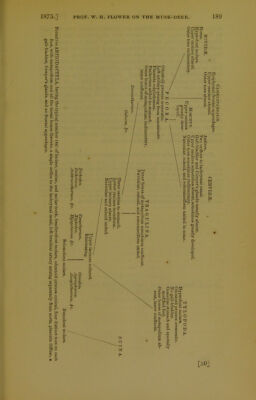
![190 simple tubercles, which I believe is a perfectly natural one, was made by W. Kowalevsky ; but the names were suggested to him by Prof. Owen, to whom this department of zoology owes so much. The modifications of the Buonodont forms, being beside the purpose of the present communication, have not been followed out. Finally, it may be asked what place must be assigned to the Musk- Deer in our necessarily imperfect and artificial method of expressing the relationship of living beings ? Should the genus Moschus be described as constituting a distinct family, Moschidcel As I appre- hend the value of the term “ family,” I think it should not. The characters which absolutely separate' it from all the recognized Cer- vidcp., it Ilydropotes is included among them, are very trifling; and to include Ilydropotes with Moschus in one family, and leave all the other Cervidce in another, appears to be a violation of natural affinities. It therefore appears most expedient to include them both as distinct generic modifications of the great family Cervidce, recognizing of course that though a convenient it is not an absolutely perfect method of expressing their position in nature. Note to the tabular view of the Classification of Artiodactyla. The form of the odontoid process in the Tylopoda might lead to the idea that they were segregated from the Ruminant stock after the Tragulina had been given off; but as it is also found in the horse, it is probably adaptive, as are the hypsodont molars. The union of the inner, and loss of the outer, bones of the metapodium is also a character not significant of very close relationship to the Pccora, as the tendency to this modification begins in the earliest peripd of the history of the group with which we are acquainted, as in Anoplotlierium, and crops out even in some of the bunodonts, as the Peccaries. [From the Proceedings of the Zoological Society of London, March 16, 1875.] M](https://iiif.wellcomecollection.org/image/b22455310_0034.jp2/full/800%2C/0/default.jpg)