On the structure and affinities of the musk-deer (Moschus mosciferus, Linn.) / by William Henry Flower.
- William Henry Flower
- Date:
- 1875
Licence: Public Domain Mark
Credit: On the structure and affinities of the musk-deer (Moschus mosciferus, Linn.) / by William Henry Flower. Source: Wellcome Collection.
Provider: This material has been provided by The Royal College of Surgeons of England. The original may be consulted at The Royal College of Surgeons of England.
5/32 page 163
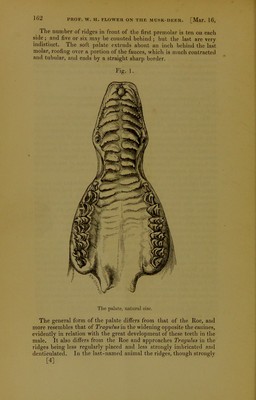
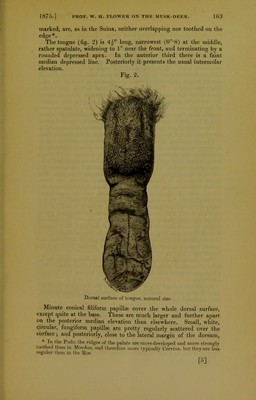
![marked, are, as in the Suina, neither overlapping nor toothed on the edge*. The tongue (fig. 2) is 4| long, narrowest (0‘8) at the middle, rather spatulate, widening to \ near the front, and terminating by a rounded depressed apex. [n the anterior third there is a faint median depressed line. Posteriorly it presents the usual intermolar elevation. Fig. 2. Dorsal surface of tongue, natural size. Minute conical filiform papillae cover the whole dorsal surface, except quite at the base. These are much larger and further apart on the posterior median elevation than elsewhere. Small, white, circular, fungiform papillae are pretty regularly scattered over the surface; and posteriorly, close to the lateral margin of the dorsum, * In the Pudu the ridges of the palate are more developed and more strongly toothed than in Mo&chus, and therefore more typically Cervine, but they are less regular than in the Roe. [5]](https://iiif.wellcomecollection.org/image/b22455310_0007.jp2/full/800%2C/0/default.jpg)