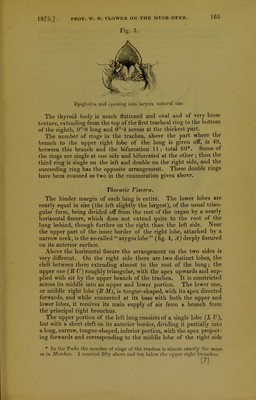
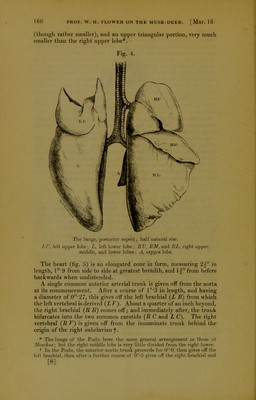
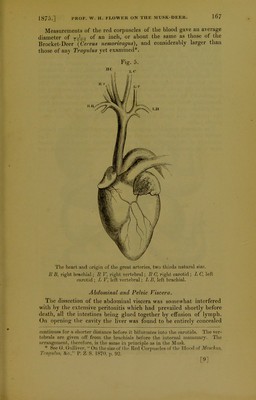
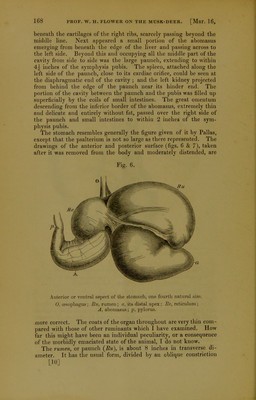
On the structure and affinities of the musk-deer (Moschus mosciferus, Linn.) / by William Henry Flower.
- William Henry Flower
- Date:
- 1875
Licence: Public Domain Mark
Credit: On the structure and affinities of the musk-deer (Moschus mosciferus, Linn.) / by William Henry Flower. Source: Wellcome Collection.
Provider: This material has been provided by The Royal College of Surgeons of England. The original may be consulted at The Royal College of Surgeons of England.
1/32
![moscliiferus, -Linn.). By William Henry Flower, F.R.S., Y.P.Z.S., &c. Almost all our knowledge of the visceral anatomy of the Musk- Deer is derived from Pallas*. It is nearly a century since his clas- sical work was published ; and it does not appear that any other anato- mist has had an opportunity of dissecting an animal of the species, the subject which furnished the material for the following notes having been the first which has ever been brought alive to Europe. Its arrival in the Society’s Menagerie was thus announced by our Secre- tary in the ‘Proceedings’ for May 13th, 1869 :— “ A female Musk (Moschus moscliiferus), presented by Major F. R. Pollock t, Commissioner at Peshawur, and most carefully con- veyed to this country by Lieut. C. H. T. Marshall, F.Z.S., from whom it was received March 31st. This animal had been captured in June 1867, in the hills of Cashmere, by Major Delme Radcliffe, of the 88th Regiment, who shot both the parents, and brought it when quite a kid to Peshawur. It was now about two years old, and was believed to be the only Musk ever brought to Europe alive.” A very good figure, drawn from the living animal in a character- istic attitude, appeared in the ‘ Illustrated London News ’ for April 24th, 1869. I call particular attention to this, as all other published figures of the Musk-Deer appear to have been taken from skins or stuffed specimens, and give but an indifferent idea of the general ex- ternal appearance of the animal. It unfortunately died on October 27th of the same year, of pleuro- pneumonia and acute peritonitis, being then rather more than two and a half years old. All the permanent teeth were in place and the epi- physes of the long bones completely united, though those on the bodies of some of the dorsal vertebrae and on the pelvis were still separable. The animal measured from the tip of the nose to the root of the tail 33 inches, and (being in an extreme state of emaciation) weighed 141bs. 8oz.^ External Characters. Under this heading I have only thought necessary to record such characters as are not readily observed in mounted skills of the animal, which are now tolerably abundant in museums. * Spicilegia Zoologica, fasciculus xiii (1779). t Now Sir Richard Pollock, K.C.S.I. t Since the greater part of the following description was written, a male Pudu (Cervus humilis) died at the Society's Gardens; and Mr. Garrod has been so obliging as to forward it for my inspection. I have thus an opportunity of adding some comparisons between the viscera of the Musk and those of another Deer of about the same bulk; for though the former, having longer limbs and neck, has the appearance of being a considerably larger animal, there is but little difference in the size of the trunk. [1]](https://iiif.wellcomecollection.org/image/b22455310_0003.jp2/full/800%2C/0/default.jpg)