An inquiry into some points in uterine and ovarian physiology and pathology in rabbits / by C.J. Bond.
- Charles John Bond
- Date:
- 1906
Licence: In copyright
Credit: An inquiry into some points in uterine and ovarian physiology and pathology in rabbits / by C.J. Bond. Source: Wellcome Collection.
Provider: This material has been provided by The Royal College of Surgeons of England. The original may be consulted at The Royal College of Surgeons of England.
11/19 page 5
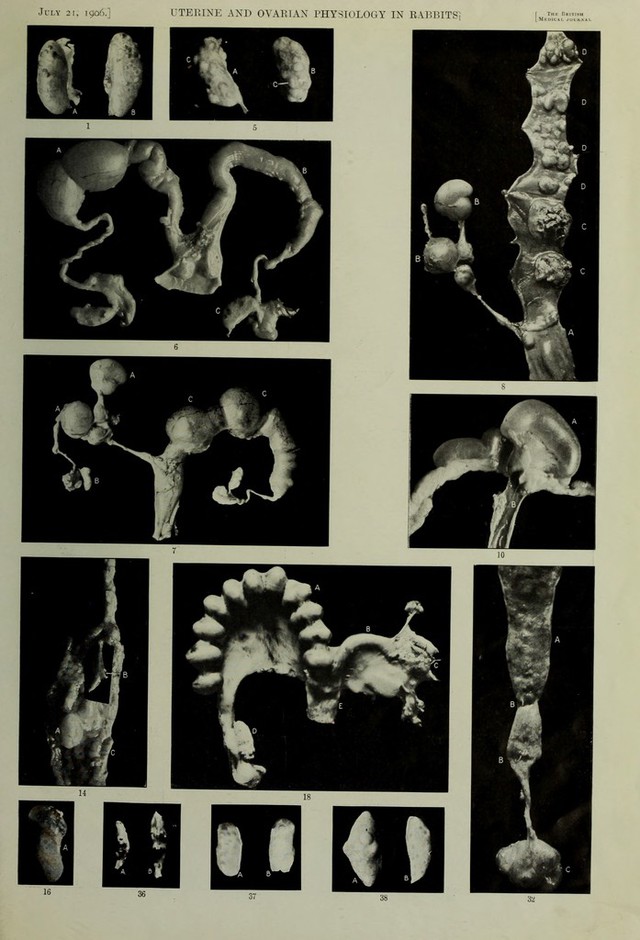
![Tho Experiment XIX (Rabbit 8). 1 igatu/ed on°Februar^ UfoYmin the Hght Uterine cornu Fig. 13,b„«s fife’ll^‘ovBrTe, .“X SS,k,‘ll,d “* dV‘> I*'- left being d„ub,e the .fof the right d “m‘,‘son' “>« In all these five experiments, repeated coitus hid occurred after the removal of the one ovary and with the exceptmn of Experiment XV pregnancy onc^e? or Seated tantTn^that cm? ^ ; that this associ«tion is impoi- C0ltus> or Pregnancy, or both are important stimuli in connexion with the compensatory hypertrophy winch occurred in the remaining ovary in theseases is shown by the fact, that when after removal of one ovary coitus and consequently pregnancy are prevented, little or o compensatory hypertrophy occurs, thus : ... Experiment XX (Rabbit 19) onJulvfnd 0iqnT Wv ren?oved in a three-parts grown rabbit ssmmmrnrn Thp „ Experiment XXI (Rabbit 25). rue right ovary was removed on July 25fh TQfis \t„ •* was allowed. The animal was killedon October 22nd Vo compensatory hypertr°p,iy was founda i? the left ovaJV g. 37 shows the two ovaries, which are equal in weight/ Y' Th« ExPeri™ent XXII (Rabbit 18). isfb'isos8 dTUhi“f P'T*“V« J«M ®S5mJ usual proportion between the ovary of the nm? when the that of the pregnant condition is considered. fB^fnterta* of month 0W6Ver’ ‘n tWs °aSe after °Peration -as less than on! The next experiment can be usefully compared with Experiment XV (Rabbit 3). compared with Th. whole AffSTiiSf«jffiu. left „„ Pig. 38) d f th P°ra lutea present in the latter (see RABBITS. f Thk Ukitisii LMcdiual Juuhna the presence of spermatozoa in the uterus which actually determines and provokes the rupture o7 the mature foBides and brings about the shedding of the ova copulation °Vsei’vatl0ns confirm this, as far as the act of copulation is concerned. If a rabbit be killed from t0 forty'eiSht hours after the occurrence S . d,ui..m,f oestrus and the ovaries be carefully exammed fuBy mature, red, raised follicles will be found lddin£ the surface of the glands with the umbilicated Htflp? f*aractenstlc of recent rupture, and in many cases the Cl°‘ °r ^ *re ,0U',d a“llwi<! to F,v 41 Experiment XXIII* (Rabbit15). after°'coiti?7he ?8anv» °f * ra.bbit killed twenty-four hours matur^folficlts6 The r^t o^rv‘hfd ^ Jllst-Ptured operation during pregnancy one month earlier! remove 7 Thus, in these four last experiments no coRus and consequently no pregnancy, occurred after the removal of the one ovary, and when the animals were killed at p riods from one month to three months after the opera- remain^n?TenSat0r^hypertr0phy was discovered in the (Experiment Sill, the uterns'Ts'“also removed, as ,n Experiment XV (Rabbit 5). in whfell fase “arv*3 the°diff nSat°ryi OCCUrred in the remaining ovary, the difference being, however, that freauent coitus occurred in Experiment XV, while in the last fxfeiwft ( vperiment XXIII, Rabbit 23) it was not permitted. The consideration of these facts strongly supports the nclusion that the-occurrence of sexual intercourse or JSZXS- °r b°th’ 3re “ the of fpe rabwf powerful stimuli of ovarian growth and function, and cause com- pensatory hypertrophy to take place in an ovary after removal of the corresponding organ or half the sum total of ovarian gland substance some time previously caSi:^ careful to apply this statement to the c,l0 hf,lt °n y' In,the human female, in several renfovaf /? U personal experience, in which, after lemoval of one ovary and tube some years earlier it became necessary to remove the remaining ofary no striking increase in size was noticeable. Further obser- fim!°nfSHre necessary 011 this point- and a]so on the ques- nnLt 1 /C?UrrenCe °f compensatory hypertrophy after unilateral oophorectomy in other animals besides rabbits under varying conditions. _ . Coitus and Ovulation. „„T“,re ia’ fm-ever, one point of importance in this con- nexion. It lias been shown by W. H. Heape (1897) that hatever may be the relationship between oestrus and ovulatmn in many animals, in the rabbit, at all events, it s the stimulus of coitus occurring during oestrus, and o. 0 ., Experiment XXIlIb (Rabbit 16). *SSS£r “d P0'nt t0 datermine was th(‘ actual factor in the OTarv waTf?nS °r ?iS Stimu]a,ing effect on the ovaiy. V as it the nervous stimulus of copulation ending in increased vascular turgescence of the ovarian vessels” or the presence of semen in the genital canaVof the female rabbit which caused the result ? JSedtj^rj,hi;srnt artmcia1' » ... Experiment XXIV (Rabbit 29) After ascertaining that the animal was in the condition nf oestrus, semen from the vagina of another rabbit h?st imnrec 1904ed Tn 'n,eC ?d lnt? tbe vagina of Rabbit 29 on March 15th Thus insemination without coitus is not as effectual as an ovarian stimulus as coitus and insemination. (See also Experiment XXVI, Rabbit 27.) K ° no?nfinthL0tber hand’ C0itus withoufc insemination is .ntiX 1,1 8aUS,,,g dehls“»“ bonus with Experiment XXV (Rabbit 28) A--/ag,nlal was formed on March 1st 1905 hv thrfow?theVag-ina,acri>SS Witbin tbe abdomen, and^ “sing the lower or vaginal end, and returning it into the abdomon^ and fixing the upper or uterine end to the skin on the surface of the abdomen. Oestrus and repeated coitus occurred a? 1904 fn+Dte'-VuA and 5he animal was killed on June 14th 1904, forty-eght hours after coitus. An examination of the o aries showed some follicles in various stages of growlh but none quite mature or recently ruptured. In connexion with th/«'ietFe,lmellt alf“0 tWO ’^cresting facts may be mentioned ■ J“) lt.'f'as iio'iced on examination of the two os uteri (which ere quite visible on bolding open the edges of the vaginal fistula opening on the abdomen) that during oestrus \nd immediately after coitus bad taken place, or even during the manipulation necessary to expose the os uteri paroxysmal erectile movements occurred in each cervix uteri at frequent intervals each cervix elongating everting the mucous mem- brane of tbe endometrium at each os, and standing promi act”on subsided h,/1™’ th<?n as,theftrgescence and muscular action subsided the cervix contracted and tbe endometrium was drawn in again. Such a < ondition of the cervix uteri and os, and such movements as these must be powerful agents in vIu7untn *hIOStfP,?raping’ ,he SPminal fluid from ih/vaginal \ault into the uterine cornua, and would seem calculated to ensure the impregnation of the animal alter coitus (o) If during these periods of oestrus and sexual excitement an inspection of the os uteri is made, a thin watery discharge th! tbrn° 'ad exuding from each os uteri, which is probably the saline secretion peculiar to the uterus which I have DrZ viously described, mixed with a certain amount of cervmal mucus, and it is interesting to note that this has a peculiar odour exactly rpsembling that of the liquor amnii and sebaceous covering ot the human felus when just born. One other point remained to be settled : that is, whether seminal fluid itself, apart from the living spermatozoa exercises any stimulating influence on the ovaries when injected into the genital canal of the female rabbit. Experiment XXVI (Rabbit S3), A solution of previously desiccated semen in water was injected into the vagina during oestrus—under the micro- 'T tb,s dnld consisted of epithelial cells and dead sperma- tozoa on April 15th, 1904. The rabbit was killed twenty-four ineitliter' No veT mature or dehisced follicles were seen](https://iiif.wellcomecollection.org/image/b22473889_0013.jp2/full/800%2C/0/default.jpg)