An inquiry into some points in uterine and ovarian physiology and pathology in rabbits / by C.J. Bond.
- Charles John Bond
- Date:
- 1906
Licence: In copyright
Credit: An inquiry into some points in uterine and ovarian physiology and pathology in rabbits / by C.J. Bond. Source: Wellcome Collection.
Provider: This material has been provided by The Royal College of Surgeons of England. The original may be consulted at The Royal College of Surgeons of England.
9/19 page 3
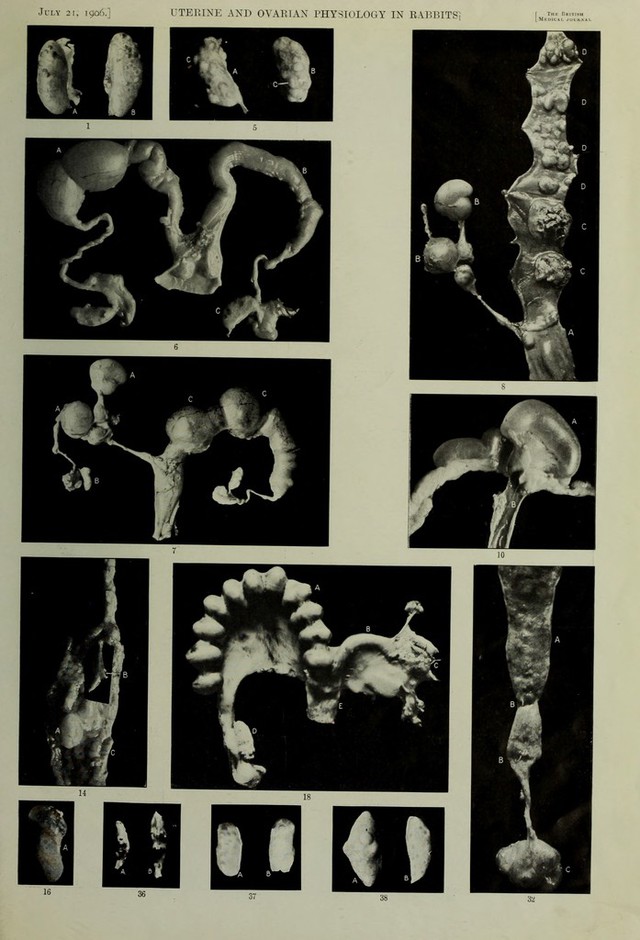
![r The British LMkuICAI. Joi'ItNAL UTERINE AND OVARIAN PHYSIOLOGY’' IN RABBITS. 3 These experiments show that if the uterine cornu be ligatured after impregnation has occurred, no saline secretion occurs, and no distension of the occluded tube by hydrometric fluid. Tiie same absence of saline uterine secretion was observed in the uterine fistula in Rabbit 21, after the * occurrence of pregnancy, while continuously present in Rabbit 16, in which pregnancy did not occur. The apparent exceptions in which ligatured portions of uterine cornu have been found distended by saline fluid at the necropsy (pregnancy being also present) are piobably due to the fact that the collection of secretion occurred before the occurrence of pregnancy and remained during its continuance. A\ e have seen that this secretion occurs independently of any ovarian influence, and that it is present in trans- planted portions of cornu in which all nervous influence lias been severed. An extended inquiry into this function of the oviduct in animals below the mammalia would probably yield valuable information as to the steps by which the function of the endometrium in the higher vertebrates has been evolved. It is, at any rate, a suggestive fact that in the human female, while the lower or uterine portion of the oviduct has undergone special changes, the secretion of the upper portion or Fallopian tube still remains a saline watery fluid like that of the whole duct (uterus and Fallopian tube) in the lower mammals. It is certain that this secretion of the endometrium must bear some reference to the nutrition, while in the duct, of the ova shed by the ovary, and it is impossible not to be struck by the marked saline character of this watery fluid and its resemblance to sea water, as far as chemical constitution is concerned.* Is it possible that we have here in this fact a relic of the earlier stages of veitebrate evolution, in which, as in the aquatic species, the ova were shed into sea water ? One other point about this saline secretion still remains, and that an important one. Under ordinary conditions of patency of the canal no collection of secretion occurs, no distension of the tube by fluid under pressure, and any fluid that is secreted by the endometrium is either resorbed or flows into the vagina. Under the altered conditions of a ligatured cornu the fluid is retained under a certain degree of pressure, and the question arises as to what influence this retained secretion exercises on the uterus, on the ovaiies, and on the animal itself ? Influence of this Uterine Secretion on the Uterus. In nearly all cases of double ligature of one uterine cornu and retention of saline secretion, some interference has occurred with the normal sequence of oestrus, coitus, impregnation, and the imbedding of the fertilized ova on the endometrium of the healthy cornu. («) Sexual appetite is not abolished; on the contrary, the oestral period is prolonged, and occurs more frequently than is natural. Thus, in Rabbit 30, in which a trans- planted portion of the uterine cornu had become hydro- metric, repeated coitus occurred every few days from March 16th (two weeks after operation) till May 20th, and pregnancy only occurred at this latter date, and after atrophy of the transplanted portions of the cornu had become complete. The same frequency of coitus and absence of pregnancy occurred also in Rabbit, 31. (b) Interference with the normal imbedding of ferti- lized ova in the endometrium occurs, or if the ova have become imbedded, there is a great tendency for aboition to occur that is, there is some interfering influence exercised by the retained fluid on the normal relationship between trophoblast and endometrium. Thus ; Experiment XI (Rabbit 31). transplantation of the right uterine cornu only two fertilized ova succeeded in establishing themselves in the lower portion of the left or healthy cornu. (Fie. 7.) On opening the cornu, the mucous membrane of the tube above the fetal sac was found covered with numerous sessile, mucous polypi (see Fig. 8), which on microscopic section were found to be adenomata. (See Fig. 15.) A quantitative chemical analysis of hydrosalpinx flid from the human subject, gives 10.12 parts per 1,000 of sodium chloride The P™P°rtion in blood plasma and serous fluids being 6 or 7 parts per 1.000. Sea water has a specific gravity of about 1,022 and contains 25 parts per 1,000 of sodium chloride. These adenomatous polypi are, I believe, the sites of the imbedding of abortive ova, or abortive placental attach- ments. This is rendered likely from the fact that the lower and larger of the polypoid masses resembles a placental site after an earl)'abortion, and has a central umbilieated necrotic area, and contains syncytial cells. Experiment XII (Rabbit 14). That the association of retained secret'ou and a polypoid or adtnomafous cond i tion of the endome trium is not an accidental one is rendered probable by this experiment, in which the Jett extreme cornu was doubly ligatured on June 3rd, 1903 Re- peated orstrus occuried, but no coitus was allowed, and when the animal was killed on July 5th, 1903, the left or ligatured cornu was found und stendrd, because the ligatures had already cut their way through the mucous membrane, and the patency of the canal was resior. d. Ibe upper portion of the tube, however, contained two polypi, one villous and pedunculated, one sessile and adeno- matus. big. 14 sho«s the polypi in position, and Fig. 15 the microscopical appearance of a section of the lower growth under a low power. In this case al-o the right or remaining ovary was cystic (big. 16 and Fig. 17), the only occasion on which I have detected a pathological cyst in a rabbit’s ovary. The left ovary was removed at the operation. The Influence of this Uterine Secretion on the Ovaries. (c) It was thought that some light might be thrown on the question of uterine influence on ovarian function by experimental inteiference with the conditions under which this uterine saline secretion is produced. It is, of course, well known that die presence of a fertilized ovum, or ova imbedded in the endometrium, the presence in fact of a living trophoblast, is necessary to ensure the active growth of lutein tissue in the ruptured follicles in the ovaries, and that these corpora lutea are necessary for the continued nutrition of the trophoblast within the uterus until the placenta has formed. (See Fraenkel, Marsha'] and Jolly, and others.) The question arises as to the manner in which this stimulus is conveyed to the ovary. It is by blood stream or by nerve impulse? By wliat means, in fact, does the ovary become awrare, so to speak, of the occurrence of pregnancy? That some reaction between endometrium and tropho- blast is necessary for the stimulus to occur is rendered probable by the fact that in cases of pregnancy occurring outside the uterus, either abdominally or in the broad ligament in the human subject, the corresponding corpora lutea are ill developed, while for the purpose of this reaction the cavity of the Fallopian tube and uterus may be regarded as one membrane. It is quite possible that a substance may be elaborated at the site of this reaction between trophoblast and uterine epithelium, which, circulating in the blood, exercises this stimulating influence on the lutein cells of • the ovary. And further, it is probable that this hypothetical sub- stance, and some constituent in the saline uterine secre- tion, are mutually antagonistic as far as their effect on the lutein cells of the ovary is concerned. An attempt was made to throw light on this question of the transference of the ovarian stimulus (by circulation or nerve influence) by transplanting one ovary and then observing the effect on the corpora lutea in the trans- planted ovary at a subsequent pregnancy. Unfortunately it frequently happens that atrophic changes occur in the transplanted ovary, which abolish or render doubtful any subsequent effects of pregnancy. Experiment XIII (Rabbit 12). Tberigbt ovary wiih the mesovarium was entirely detached and transplanted to the parietal peritoneum in the right flank, May 25tb, 1903. Primary aseptic healing occurred. The animal betame pregnant on June 19th producing nine young. Pregnancy again occurred on July 27th, and the animal was killed on August 7th. The left uterine cornu contained eleven fetuses (Fig 18), and the left ovary eleven corpora lutea. The right or transplanted ovary could be recognized with difficulty, and had undergone atrophic degenerative changes, and no corpora lutea could be detected. Experiment XIV (Rabbit 17). The right ovary was transplanted to the peritoneum over the right psoas muscle in two stages. In the first stage on June 13th. 1903, the ovary was freed from all attachments to surrounding parts, except its attachment to the Fallopian tube ; the ovary, however, broke away from this anchorage and](https://iiif.wellcomecollection.org/image/b22473889_0011.jp2/full/800%2C/0/default.jpg)