Handbook of the science and practice of medicine / by William Aitken.
- William Aitken
- Date:
- 1858
Licence: Public Domain Mark
Credit: Handbook of the science and practice of medicine / by William Aitken. Source: Wellcome Collection.
Provider: This material has been provided by The University of Glasgow Library. The original may be consulted at The University of Glasgow Library.
854/880 (page 736)
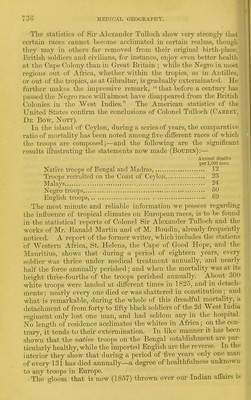
![The statistics of Sii- Alexander Tulloch show very strongly that certain races cannot become acclimated in ceitain realms, though they may in others far removed from their original Vjiith-])lac<*. British soldiers and civilians, for instance, enjoy even better health at the Cape Colony than in Great Britain ; while the Negi-o in most regions out of Africa, whether witliin the tropics, as in Antilles, or out of the tropics, as at Gibraltar, is gradually extei-minated. He further makes the impressive remark, that before a centuiy has ]iassed the Negro i-ace will almost have disappeared from the BritLsh Colonies in the West Indies. The American statistics of the United States confirm the conclusions of Colonel Tulloch (Cahre\', De Bow, Nott). In the island of Ceylon, during a series of years, the comparative ratio of mortality has been noted among five different races of which the troops are composed;—and the following are the significant results illustrating the statements now made (Boudin):— Annnnl deatlis per 1,000 mei:. Native troops of Bengal and Madras, 12 Troops recruited on the Coast of Ceylon, 23 Malays, 24 Negro troops, '^O English troops, 69 The most minute and reliable information we possess regarding the influence of tropical climates on European races, is to be found in the statistical reports of Colonel Sir Alexander TuUoch and the works of Mr. Ranald Martin and of M. Boudin, already frequently noticed. A report of the former writer, which includes the stations of Western Africa, St. Helena, the Cape of Good Hope, and the Mauritius, shows that diu-ing a period of eighteen years, every soldier was thrice under medical treatment annually, and nearly haht' the force annually perished; and when the mortality was at its height three-fourths of the troops perished annually. About 301) white troops were landed at different times in 1825, and in detach- ments ; nearly every one died or was shattered in constitution; and what is remarkable, diu-ing the whole of this di-eadful mortality, a detachment of from forty to fifty black soldiers of the 2d West India regiment only lost one man, and had seldom any in the hospital. No length of residence acclimates the whites in Africa; on the con- trary, it tends to their extermination. In like manner it has been shown that the native troops on the Bengal establishment are jiar- ticularly healthy, while the imported English are the revei-se. In the interior they show that during a period of five years only one man of every 131 has died annually—a degree of healthfulness unknown to any troops in Europe. . The gloom that is now (1857) thrown over our Indian affau-s is](https://iiif.wellcomecollection.org/image/b21462288_0856.jp2/full/800%2C/0/default.jpg)