Albert von Haller and the Disputationes chirurgicae selectae / by Sir DArcy Power, K.B.E., F.R.C.S. Eng.
- D'Arcy Power
- Date:
- 1926
Licence: In copyright
Credit: Albert von Haller and the Disputationes chirurgicae selectae / by Sir DArcy Power, K.B.E., F.R.C.S. Eng. Source: Wellcome Collection.
7/20 (page 5)
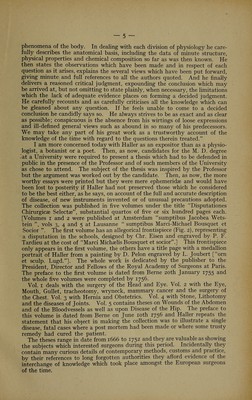
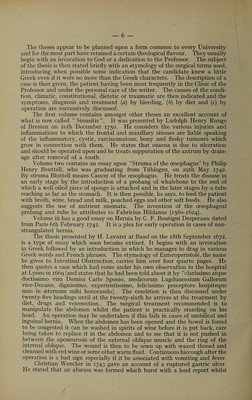
![phenomena of the body. In dealing with each division of physiology he care¬ fully describes the anatomical basis, including the data of minute structure, physical properties and chemical composition so far as was then known. He then states the observations which have been made and in respect of each question as it arises, explains the several views which have been put forward, giving minute and full references to all the authors quoted. And he finally delivers a reasoned critical judgment, expounding the conclusion which may be arrived at, but not omitting to state plainly, when necessary, the limitations which the lack of adequate evidence places on forming a decided judgment. He carefully recounts and as carefully criticises all the knowledge which can be gleaned about any question. If he feels unable to come to a decided conclusion he candidly says so. He always strives to be as exact and as clear as possible; conspicuous is the absence from his wirtings of loose expressions and ill-defined general views such as abound in so many of his predecessors. We may take any part of his great work as a trustworthy account of the knowledge of the time with regard to the questions therein treated.” I am more concerned today with Haller as an expositor than as a physio¬ logist, a botanist or a poet. Then, as now, candidates for the M. D. degree at a University were required to present a thesis which had to be defended in public in the presence of the Professor and of such members of the University as chose to attend. The subject of the thesis was inspired by the Professor but the argument was worked out by the candidate. Then, as now, the more worthy essays were printed but they were mere ephemeridas and would have been lost to posterity if Haller had not preserved those which he considered to be the best either, as he says, on account of the full and accurate description of disease, of new instruments invented or of unusual precautions adopted. The collection was published in five volumes under the title “Disputationes Chirurgicae Selectee”, substantial quartos of five or six hundred pages each. [Volumes i and 2 were published at Amsterdam “sumptibus Jacobea Wets- tein ”, vols 3, 4 and 5 at Lausanne “ sumptibus Marci-Michael Bousquet et Socior ”. The first volume has an allegorical frontispiece (Fig. 2), representing a disputation in the schools, designed by Chr. Eisen and engraved by P. F. Tardieu at the cost of “Marci Michaelis Bousquet et socior”.] This frontispiece only appears in the first volume, the others have a title page with a medallion portrait of Haller from a painting by D. Pelon engraved by L. Joubert [“orn et sculp. Lugd.”]. The whole work is dedicated by the publisher to the President, Director and Fellows of the Royal Academy of Surgeons at Paris. The preface to the first volume is dated from Berne 20th January 1755 and the whole five volumes were completed by 1756. Vol. 1 deals with the surgery of the Head and Eye. Vol. 2 with the Eye, Mouth, Gulletj tracheotomy, wryneck, mammary cancer and the surgery of the Chest. Vol. 3 with Hernia and Obstetrics. Vol. 4 with Stone, Lithotomy and the diseases of Joints. Vol. 5 contains theses on Wounds of the Abdomen and of the Bloodvessels as well as upon Disease of the Hip. The preface to this volume is dated from Berne on June 10th 1756 and Haller repeats the statement that his object in making the collection was to illustrate a single disease, fatal cases where a post mortem had been made or where some trusty remedy had cured the patient. The theses range in date from 1666 to 1752 and they are valuable as showing the subjects which interested surgeons during this period. Incidentally they contain many curious details of contemporary methods, customs and practice, by their references to long forgotten authorities they afford evidence of the interchange of knowledge which took place amongst the European surgeons of the time.](https://iiif.wellcomecollection.org/image/b30801126_0007.jp2/full/800%2C/0/default.jpg)