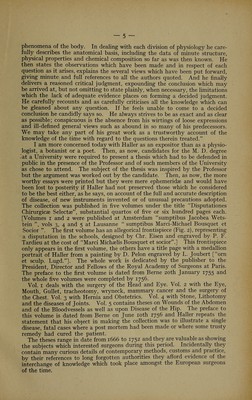
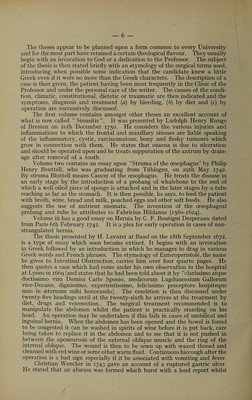
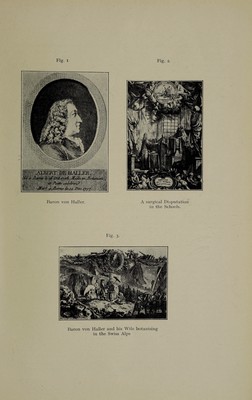
Albert von Haller and the Disputationes chirurgicae selectae / by Sir DArcy Power, K.B.E., F.R.C.S. Eng.
- D'Arcy Power
- Date:
- 1926
Licence: In copyright
Credit: Albert von Haller and the Disputationes chirurgicae selectae / by Sir DArcy Power, K.B.E., F.R.C.S. Eng. Source: Wellcome Collection.
8/20 (page 6)
![The theses appear to be planned upon a form common to every University and for the most part have retained a certain theological flavour. They usually begin with an invocation to God or a dedication to the Professor. The subject of the thesis is then stated briefly with an etymology of the surgical terms used, introducing when possible some indication that the candidate knew a little Greek even if it were no more than the Greek characters. The description of a case is then given, the patient having been most frequently in the Clinic of the Professor and under the personal care of the writer. The causes of the condi¬ tion, climatic, constitutional, dietetic or traumatic are then indicated and the symptoms, diagnosis and treatment [a) by bleeding, (b) by diet and (c) by operation are successively discussed. The first volume contains amongst other theses an excellent account of what is now called “ Sinusitis ”. It was presented by Ludolph Henry Runge of Bremen on ioth December 1750. He considers the various injuries and inflammations to which the frontal and maxillary sinuses are liable speaking of the inflammatory, cystic, carcinomatous, bony and fleshy tumours which grow in connection with them. He states that ozaena is due to ulceration and should be operated upon and he treats suppuration of the antrum by drain¬ age after removal of a tooth. Volume two contains an essay upon “Struma of the oesophagus” by Philip Henry Beuttell, who was graduating from Tubingen, on 29th May 1742. By struma Bluttell means Cancer of the oesophagus. He treats the disease in an early stage by the introduction of a probang of whalebone to the end of which a well oiled piece of sponge is attached and in the later stages by a tube reaching as far as the stomach. It is then possible, he says, to feed the patient with broth, wine, bread and milk, poached eggs and other soft foods. He also suggests the use of nutrient enemata. The invention of the oesophageal probang and tube he attributes to Fabricius Hildanus (1560-1624). Volume iii has a good essay on Hernia by C. F. Boutigni Desperaux dated from Paris 6th February 1742. It is a plea for early operation in cases of non- strangulated hernia. The thesis presented by H. Lavater at Basel on the 18th September 1672, is a type of essay which soon became extinct. It begins with an invocation in Greek followed by an introduction in which he manages to drag in various Greek words and French phrases. The etymology of Enteroperistole, the name he gives to Intestinal Obstruction, carries him over four quarto pages. He then quotes a case which had come under his own observation in the hospital at Lyons in 1669 [and states that he had been told about it by “clarissimo atque doctissimo viro Domini Carlo Sponio, medicorum Lugdunensium Gallorum vice-Decano, dignissimo, experientissimo, felicissimo preceptore hospiteque meo in aeternum mihi bonorando]. The condition is then discussed under twenty-five headings until at the twenty-sixth he arrives at the treatment by diet, drugs and venesection. The surgical treatment recommended is to manipulate the abdomen whilst the patient is practically standing on his head. An operation may be undertaken if this fails in cases of umbilical and inguinal hernia. When the abdomen has been opened and the bowel is found to be congested it can be washed in spirits of wine before it is put back, care being taken to replace it in the abdomen and to see that it is not pushed in between the aponeurosis of the external oblique muscle and the ring of the internal oblique. The wound is then to be sewn up with waxed thread and cleansed with red wine or some other warm fluid. Continuous hiccough after the operation is a bad sign especially if it be associated with vomiting and fever. Christian Wencker in 1743 gave an account of a ruptured gastric ulcer. He stated that an abscess was formed which burst with a loud report whilst](https://iiif.wellcomecollection.org/image/b30801126_0008.jp2/full/800%2C/0/default.jpg)